


Male Roles, Obligations and Options for Building a Fulfilling Life | Scott Galloway


Scott Galloway is a professor of marketing at New York University's Stern School of Business. We discuss masculine roles and obligations of past, present and future. We explore which are timeless and which are changing, and positive steps boys and men can take to create meaning and stability in their lives. We cover work, finances, health and relationships to build a grounded, purposeful life. We also discuss tech, social media, alcohol, cannabis and porn. Throughout, we emphasize specific daily practices for building mental, physical and economic resilience, compassion for others, and for navigating key life decisions in every realm.
Articles
- Electrical self-stimulation of the brain in man (The American Journal of Psychiatry)
Other Resources
- Neuralink
- Scott Galloway on Real Time with Bill Marr
- Carnegie Medal
- New Mexico Department of Justice Wins Landmark Verdict Against Meta
- MADD
- Planet of the Apes
- Magnolia
- Mr. Mom
Huberman Lab Episodes Mentioned
- Dr. Jonathan Haidt: How Smartphones & Social Media Impact Mental Health & the Realistic Solutions
- Coleman Ruiz: Overcoming Physical & Emotional Challenges
- What Alcohol Does to Your Body, Brain & Health
- Defining Healthy Masculinity & How to Build It | Terry Real
- Dr. Bernardo Huberman: How to Use Curiosity & Focus to Create a Joyful & Meaningful Life
People Mentioned
- Rich Roll: podcaster
- Richard Reeves: founding president, American Institute for Boys and Men
- Elon Musk: entrepreneur
- Gabriel García Márquez: writer, journalist
- Jerry Springer: broadcaster, politician
- Jocko Willink:retired Navy SEAL, author
- Jonathan Haidt: social psychologist, New York University
- Jean Twenge: professor of psychology, San Diego State University
- Judith Rapport: child psychologist
- Mark Zuckerberg: CEO of Meta
- Amy Klobuchar: US Senator
- Adam Altar: professor of marketing, New York University
- Billie Eilish: singer, songwriter
- Anna Lembke: professor and medical director of addiction medicine, Stanford University
- Lubert Stryer: professor of structural biology and neurobiology, Stanford University
- Kelly Starett: physiotherapist, author
- Jay Bhattacharyya: director, National Institutes of Health
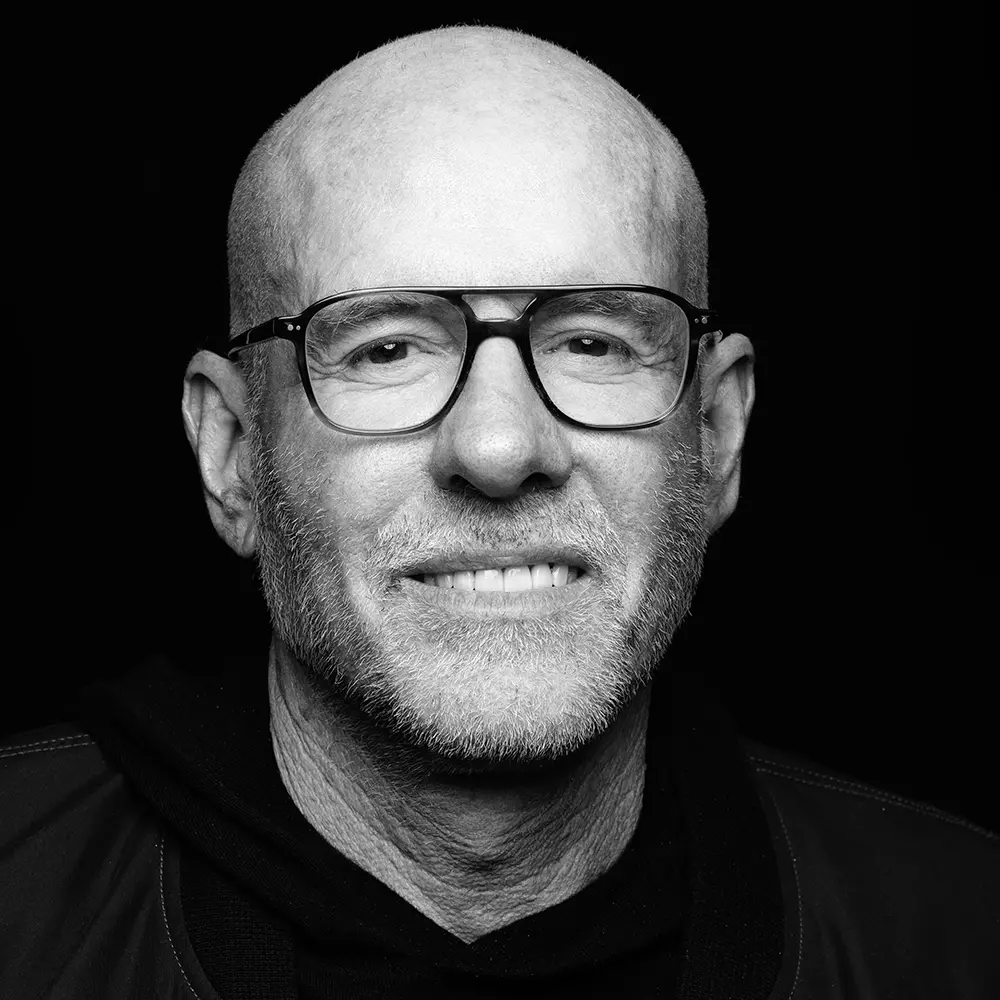
About this Guest
Scott Galloway
Scott Galloway is a professor of marketing at New York University's Stern School of Business.
This transcript is currently under human review and may contain errors. The fully reviewed version will be posted as soon as it is available.
Scott Galloway:
And this is the goal. The goal is no, because you're going to get nos. And then I'm going to call you after you've made the approach. You're going to text me, "I did an approach." "Did you get a no?" "Yeah, I got a no." That's exactly the point. That's the goal. Because everyone you admire, everyone you think has killed it, the only thing I can guarantee you is there were a ton of nos in getting to one of the top 10 podcasts in the world, getting to a person as a partner who's higher character and hotter than you, getting to make more money than you would've ever guessed that person would've made. The only thing that got them there was the willingness and the endurance to anticipate no.
Andrew Huberman:
Welcome to the Huberman Lab podcast, where we discuss science and science-based tools for everyday life. I'm Andrew Huberman, and I'm a professor of neurobiology and ophthalmology at Stanford School of Medicine. My guest today is Scott Galloway. Scott Galloway is a professor at New York University's Stern School of Business and one of the world's leading public educators on intelligent life design, including finances, relationships, and as today's conversation also covers, on the sociopolitical landscape. Today, we mainly talk about masculinity and what men, young and old, and everything in between, are facing today in terms of their roles to take in work, in relationships, and their health. And today, we don't just review the data. You'll hear statistics, so Scott is very grounded in quantitative data, which is important. But he also shares several clear, actionable steps that you can take daily to ensure that you're making progress in work and relationships and finances. We also get into a bit of debate, or more, about things like alcohol, the benevolence or lack thereof of big tech and social media, and we talk a lot about the male-female dynamics in terms of the consequences of single-mom homes and divorce, but just generally male-female dynamics. So while today's episode does include a lot of exploration of different topics that frankly I didn't anticipate, it's also very proactive. Scott delineates the things that you can do and frankly should do each day. These aren't just lists or hacks, but effective tools that come from knowledge, data, his deep thinking, and that reflect the landscape we are in now. I'm very grateful that Scott took the time for this conversation. You'll see that we agree on many things. We disagree on several. He's a very deep thinker, extremely smart, obviously. He also cares about people. That comes through over and over again, and he's extremely generous today on your behalf with indeed tough love knowledge. Before we begin, I'd like to emphasize that this podcast is separate from my teaching and research roles at Stanford. It is, however, part of my desire and effort to bring zero cost to consumer information about science and science-related tools to the general public. In keeping with that theme, today's episode does include sponsors. And now for my discussion with Scott Galloway. Scott Galloway, welcome.
Scott Galloway:
Thanks, man. It's good to see you. Actually, I was nervous driving over here. I like you and respect you and was thinking, I was trying to figure out why I was nervous, and I really want to do well today. And the last time I had this feeling was when I was going to do Rich Roll's podcast. Like you, I really like and respect Rich, and I remember thinking, I had that same feeling, I wanted to do well. Anyways, good to be here.
Andrew Huberman:
Oh, man. Well, great to have you here.
Scott Galloway:
Despite my nerves.
Andrew Huberman:
It's funny you say that because I was coming here and I was thinking, yeah, I look up to Scott.
Scott Galloway:
Oh, thanks.
Andrew Huberman:
I respect him, and we've had one conversation prior to this that ended up being quite extended conversation. And I told Rob right before coming in here, our producer, I'm super fired up to-
Scott Galloway:
Thanks, man
Andrew Huberman:
... to learn from you and-
Scott Galloway:
Good
Andrew Huberman:
... just sit down and chat with you. So I actually am going to do something differently this podcast than any other podcast, which is the question I'm about to ask or-
Scott Galloway:
Mm-hmm
Andrew Huberman:
... the kind of thing I'm about to pose, I normally would do off camera.
Scott Galloway:
Okay.
Andrew Huberman:
I'm going to do it on camera, which is coming in here today, it occurred to me that we, as a, how old are you?
Scott Galloway:
I'm going to be 62 in November.
Andrew Huberman:
62. You look great, man.
Scott Galloway:
Thanks, man.
Andrew Huberman:
You can share what you're doing if we get the time, fitness-wise. I'm 50, and the risk we run into, I realize, is that when I was 16, 20, 30, et cetera, yes, I wanted knowledge-
Scott Galloway:
Mm-hmm
Andrew Huberman:
... maybe even wisdom from elders, but I also knew with certainty that they didn't understand a thing about what it was like to be that age at that time. So I realized that as much as we might think we know, we don't know what it's like to be 16, 25, 30, 40-year-old men, and we'll also talk about women today-
Scott Galloway:
Mm-hmm
Andrew Huberman:
... but probably mostly men, in 2026. And so how do we reconcile that in a discussion like this? I just wanted to ask you, how do you think about that? Because so much of your content and what you're teaching out there is about timeless truths, but there's also a lot of things that are happening now, not just pain points, but maybe opportunities that, I don't know. How do you think about do we really know? How should we pass along information in a way that's truly useful to people? Because that's what obviously we both want this to be about.
Scott Galloway:
Well, just what you said. You can't fully relate to a 16 if you're not 16 years old and know what they're going through. And you guys are skateboarders, and when I was 16, I got home, and it was either watch cartoons until my mom got home or it was take risks and go out and find friends and do things. And now there's so much temptation at home between big tech and having a casino in your pocket, a Netflix in your pocket, and porn in your pocket. It's just hard to relate to what they go through. I think the first thing is just acknowledging you don't know what you don't know, and then turning to data because there are people who look at the data. And I try to counter my biases or my uninformed theses with data. And so I try to find good people, good research, and inform it. Also, it helps I have 15 and 18-year-old sons. I ask them a lot. I observe them a lot. I hang out with them a lot. And you start to pick up on stuff. But I think the first is just being open to people pushing back and recognizing, unfortunately, every once in a while in the comment when someone points something out and going, if it really hurts and it's upsetting, it's usually because they're right And they found some soft tissue, and they pressed on it. And I try to be open to learning and just acknowledging when I got it wrong.
Andrew Huberman:
What do you think are the, could be three, could be five, could be 10 things that all males should strive to check the boxes on in order to have a good life? Not just to be great in some particular role, but what are the macronutrients, in your opinion-
Scott Galloway:
Mm-hmm
Andrew Huberman:
... of becoming a healthy, happy, fulfilled male?
Scott Galloway:
I think every person, not just every man, needs a code. And that is you're going to be faced with hundreds of decisions each day, and you want to make, generally speaking, a higher proportion of good decisions than the peer group, right? So what helps is a code. Some people get that code from religion, the military, their really strong family connections. I actually got my first code from my first job. I worked at Morgan Stanley, and there was just a certain level of professionalism. I got code from sports at UCLA. But I wonder, there's so many lost men right now, I wonder if masculinity can be a code or some sort of aspirational form of masculinity where people born as males might have an easier time leaning in. And I should also say that I don't think masculinity or femininity are sequestered to people born as males or females. I'm drawn to men who are more feminine as friends. My close friends kind of take care of me and are more nurturing. But I think for young men, if they feel like they can lean into some positive masculine attributes, it could serve as a code. So I loosely break it down into three very reductive qualities, and that is the first is to be a provider. I'm not talking about the way the world is, but the way the world should be. I think every young man should have a plan and have an assumption that at some point he will have to be the economic lead or provider for his family. Sometimes that means getting out of the way of your partner who's better at that whole money thing. Sometimes it means providing more domestic or emotional support and labor if your partner's accelerating economically. When my partner had a kid, she was working at Goldman Sachs. She was making more money than me. I was a new academic at NYU. I was making $160,000 living in New York, which may sound like a lot of money, but it wasn't. And she was making substantially more. So I tried to pick up slack and provide more labor at home and take charge of our finances. But I think at the outset, trying to find a plan to be economically relevant in a capitalist society is really important because whether we like to admit it or not, a male from a self-esteem standpoint, from a sexual currency standpoint, from the esteem of the tribe or the society, is going to be disproportionately evaluated based on your economic viability. So from an early age, try and have a plan. You may not have to stick to that plan. I'm not saying you got to go to Harvard and go to work at Goldman Sachs, but maybe you're going to go to trade school, learn how to install an energy-efficient HVAC, but you just need a plan to be moving towards something. The second is protector. If you think about the most masculine jobs, fireman, cop, military, the notion is you develop skills and strengths such that you can protect others. And the most, if you will, manly, masculine, satisfied I ever feel is a night when I feel as if my family feels protected. The kids are asleep, my partner feels loved and supported, and I've been able to, hopefully through partnership, through economic viability, been able to provide a warm, comfortable life for them so they can focus on the things that are important to them. And I think unfortunately a lot of men that we should look up to, whether it's the president, I apologize for getting political, or the wealthiest man in the world who are naturally going to be seen as male role models, they seem to have skipped the protection part. That the whole shooting match, the whole reason you make money, that's the means, but the ends is such that you can protect others. I find that's the most rewarding thing in the world. And then finally, procreator. And that is, I think we need to stop demonizing young men's desire for relationships and sexual desires. I think a young man wanting to have sex can be a tremendous motivator to be a better man. It's like fire. It can be incredibly destructive, but if you put it in a steel casing with spark plugs, it can create tremendous progress. And the story I use is that I was at the Raleigh Hotel in Miami, and I saw a very attractive woman. And it was the middle of the day, and without the benefit of alcohol, I didn't have the confidence to approach her, but I promised myself I was going to approach her. And then I went out to get my car from the valet and was sitting under the car, and I'm like, "God, you're such a fucking wimp." So I ran back in, went up to her and said, "Hi, I'm Scott. Where are you from?" Anyways, long story short, 18 months later, our son's middle name born was Raleigh. And I didn't look at her, Andrew, and think, "I'd really like lower rates on auto insurance." I looked at her and thought, "I'd really like to have sex with her." And I think young men's desire for relationships and sex, if channeled correctly, makes you want to be a better man. Have a kindness practice. Demonstrate excellence. Shower, for God's sakes. Work out. Have a plan. Have resilience. Have perseverance. Demonstrate excellence. So in sum, provider, protector, procreator. Where I think I missed it in the book, and I'd love your response because I'm open to criticism here, is one, that's what worked for me, and I think a lot of younger people, there's different forms of masculinity that don't necessarily involve being economically secure or finding a mate. And also, the component I've really missed is service. And I think a great one question or proxy for masculinity in terms of what you do every day is are you optimizing for attention or service? Right? And then the litmus test that Richard Reeves kind of gave me, who's sort of my Yoda on this stuff, is this notion of surplus value. That some men are born males, but they die never having become men. It's not about a religious ceremony, an age, or some sort of experience or ritual. It's about at some point, can you honestly look in the mirror and say
Speaker 3:
I add surplus value. I create more tax revenue and jobs than I absorb. Everyone absorbs tax revenue if you're in America. I listen to more people complain than I complain, right? I love more people than love me. And I didn't get that, I don't think I really became a man well into my 40s because I took a capitalist approach to relationships. I always wanted more. I wanted a girlfriend that was better to me than I was to her. I wanted a job where I was getting paid more maybe than I was contributing. And then what you realize as you get older is the whole shooting match is to create surplus value, be a better friend, be a better partner. There's no way my kids will ever be able to return as much as I've invested in them. The Hallmark Channel and insurance commercials will tell me that I'll have these moments, and I get those. But my kids are never up at 2:00 a.m. worried about me. They just aren't. Right? I would say to them, "You're adding negative value." Just be clear. You go to these amazing schools, all these talented people, negative value. Me and your mom, we are constantly investing in you. This would be impossible for you to pay us back. What I figured out is that's the whole shooting match, is I'm finally, Andrew, finally at a place of surplus value. I apologize for the word salad. Provider, protector, procreator. Are you optimizing for service, not attention? And can you really say that you add surplus value?
Andrew Huberman:
I'd like to take a quick break to acknowledge one of our sponsors, David. David makes protein bars unlike any other. Their newest bar, the Bronze Bar, has 20 grams of protein, only 150 calories, and zero grams of sugar. I have to say, these are the best-tasting protein bars I've ever had, and I've tried a lot of protein bars over the years. These new David bars have a marshmallow base, and they're covered in chocolate coating, and they're absolutely incredible. I, of course, eat regular whole foods. I eat meat, chicken, fish, eggs, fruits, vegetables, et cetera. But I also make it a point to eat one or two David bars per day as a snack, which makes it easy to hit my protein goal of one gram of protein per pound of body weight. And that allows me to take in the protein I need without consuming excess calories. I love all the David Bronze Bar flavors, including Cookie Dough, Caramel Chocolate, Double Chocolate, Peanut Butter Chocolate. They all actually taste like candy bars. Again, they're amazing. But again, they have no sugar, and they have 20 grams of protein with just 150 calories. If you'd like to try David, you can go to davidprotein.com/huberman. Right now, David is offering a deal where if you buy four cartons, you get the fifth carton for free. You can also find David on Amazon or in stores such as Target, Walmart, and Kroger. Again, to get the fifth carton for free, go to davidprotein.com/huberman. Today's episode is also brought to us by Wealthfront. In today's financial landscape of constant market shifts and chaotic news, it's easy to feel uncertain about how to save and invest your money. Wealthfront is the solution that helps you take control of your money while managing risk. For nearly a decade, I've trusted Wealthfront to navigate this volatility. With the Wealthfront cash account, I can earn 3.3% annual percentage yield, or APY, on my cash from program banks. And I know my money is growing until I'm ready to spend it or invest it. One of the features I love about Wealthfront is that I have access to instant, no-fee withdrawals to eligible accounts 24/7. That means I can move my money where I need it without waiting. And when I'm ready to transition from saving to investing, Wealthfront lets me seamlessly transfer my funds into one of their expert-built portfolios. For a limited time, Wealthfront is offering the Huberman Lab audience an exclusive 0.75% APY boost over the base rate for three months. Meaning you can get up to 4.05% variable APY on up to $150,000 in deposits. Over one million people already trust Wealthfront to save more, earn more, and build long-term wealth with confidence. If you'd like to try Wealthfront, you can go to wealthfront.com/huberman to receive the boost offer and start earning 4.05% variable APY today. That's wealthfront.com/huberman to get started. This is a paid testimonial of Wealthfront. Client experiences will vary. Wealthfront brokerage is not a bank. The base APY is as of January 30th, 2026, and subject to change. For more information, please see the episode description.
Speaker 3:
I love all that. I don't have anything to add. I do have two questions and one reflection. The reflection is that what you started with, that every day you're making decisions all day long, and you want more of those to be good decisions than bad decisions relative to your peers. I think that's a terrific way to think about striving, and I've never heard it posed that way, so I really just want to bold, underline, and highlight that for everyone. For the eighth-grader, for the 12th-grader, for the college junior, the 40-year-old man, make better decisions than the average around you. The problem I have, I guess I do have one caveat here is that most people won't remember this, but that show "Jerry Springer," I think was so popular because people like to focus on all the people doing worse than them because it makes it easy to stay right where you're at.
Andrew Huberman:
Yeah.
Speaker 3:
So who are the comparison points that one can keep in mind as they strive to make these better decisions each day? Because I think that first statement you made is touching into some serious wisdom. So who is the comparison point, and how do you keep that framed? Because you study markets, you understand markets. What's the market comparison point in this make more better decisions than worse ones relative to the average as you progress through your day?
Andrew Huberman:
I think it's really important to, you're talking a little bit about role models and references. And so first off, one myth I think we need to dispel is that success equals exploitation. There's a very unhealthy zeitgeist, especially from the far left, that anyone who's very successful is exploiting others
Scott Galloway:
And I think we need to puncture that narrative and say you should strive to be successful. And success might mean certain things for other people. I didn't grow up with money, so for me, success for most of my life was trying to get economic security. Anxiety plagued my mom and I, economic anxiety, and it was like a ghost following us around telling us we weren't worthy. So my role models were always people who'd figured out economic success. And people have to pick their own role models. I always thought masculinity was getting back in someone's face who didn't give me the respect I thought I deserved. I was that asshole that when someone cut me off in traffic, felt like I needed to speed up and cut them off. That if the Delta ticket counter representative wasn't kind to me or was busy, I would get back in their face. It's like, "Well, do you realize I'm a 1K member?" And then, a decent reference point is just men you admire, and they're everywhere, that perhaps can take blows. They realize someone might be having a bad day. But you said something that inspired a thought and that what I just outlined is pretty meta. Kind of themes that sometimes aren't that actionable. So I just want to bring it down one level. As we were talking about off mic, I try and mentor two or three young men at any given time. And these are young men that quite frankly need mentoring. They're struggling. Most of them might be still living at home. These aren't people who went to Brown and are working at Goldman Sachs. And so just some more tactical things that I think serve as a reference point for how you succeed or how you make progress. The first thing I do, the first hack is I say, "Unlock your phone," and I'm going to look at it. And there's a little bit of nervousness. So what I do to loosen them up or lubricate it is I say, "Okay, let me tell you two things." First is I gamble. I don't gamble on FanDuel. I gamble with options. I know it's stupid. I know I'm going to lose money over the long term. I'm a smart guy. I love markets. But that dopamine hit I get is too seductive. So I sell calls and puts. I consume porn. That's an embarrassing thing to say at 61, but yeah, I still consume porn. But I tell them that, and it lubricates or it makes them more comfortable. I open their phone. Everyone has an advantage. Most young men who are not excelling, if you will, by traditional Western capitalist standards, their advantage is capital, specifically their human capital. They have time. And within about five to seven minutes, I can find eight hours of time from TikTok, from X, from porn, from gambling sites, from YouTube. I'm like, "We're going to find eight hours. You tell me where we're going to reduce this eight hours. And next week I'm going to check, and we're going to reallocate that capital into three things." The first is we're going to get really fucking strong. I just think the best antidepressant is moving weights, building some bulk, or running far. I've jokingly said every man under the age of 30 should aspire to be able to walk into any room and know if shit got real, they could kill and eat everybody or outrun them. There's different forms of fitness. You can be fast, you can be flexible, you can be strong. But there's no excuse. The male form is blessed with more bone density, double twitch muscle, all the things you talk about, this incredible substance that pours over it called testosterone. You're going to look back when you're my age and think, "Why wasn't I just fast, sleek, a monster, just strong?" So we're going to work out at least three times a week. The second thing is we got to make some money, and I want you to make money outside your house. I don't care if you're a Lyft driver, TaskRabbit, or Panera's hiring people at 18 bucks an hour, and only one out of 10 that accept a job actually show up the first day. So if you really make the effort, you can make decent money. And the great thing about getting a taste for the flesh of money is you start learning how to make more money. If you want to make a lot of money, unless you're smart enough to be born to rich parents, start off by making a little bit of money, and you'll start to figure out capitalism. Right? And the final thing is, at least three times a month, we're going to put ourselves in a group setting where we are trying to achieve something great in the agency of others, a nonprofit, a church group, a sports league, a writing club. And then the second phase of that is we're going to do something what I call is the approach. "Hey man, do you want to go watch the Jets game?" Right? An expression of friendship. And then if you're really comfortable, an expression of romantic interest while making them feel safe. "Would you like to grab a coffee sometime?" And this is the goal. The goal is no, because you're going to get nos. And then I'm going to call you after you've made the approach. You're going to text me, "I did an approach." Did you get a no? "Yeah, I got a no." That's exactly the point. That's the goal. Because everyone you admire, everyone you think has killed it, the only thing I can guarantee you is there were a shit ton of nos in getting to one of the top 10 podcasts in the world, getting to a person as a partner who's higher character and hotter than you, getting to make more money than you would have ever guessed that person would have made. The only thing that got them there was the willingness and the endurance to anticipate no. And unfortunately, big tech is setting up an algorithm that convinces you that a frictionless life is a good life and that you never need to endure no. And what you end up with is a lack of skills to persevere, to realize you're okay. And that's what I ask the kids the next day. "Are you okay?" "Yeah, I'm bummed out." But you're okay. If a man under the age of 30 works out three times a week, works 30 hours a week outside of the house, right, and is volunteering, that immediately puts him in the top 8% of all young men. And I apologize for the word salad here, but something I hate is the incel movement. Involuntarily celibate. Right? Throughout history, 99% of men have been involuntarily celibate for most of their lives. There's few things young men would rather be doing than having sex. Only 40% of men have reproduced throughout history, 80% of women. So no man has a birthright to reproduce. In the West, it's actually now 75%. So young men have more agency than they ever have. Now, if you do those things, right Just those three things, work outside of the house, work out, have a kindness practice, volunteer in the service of others, you're immediately going to put yourself in the top decile of young men. And if you're in the top decile of young men, I can guarantee you, over time, you will become voluntarily incelibate, which is awesome, because you'll establish a relationship. And young men under the age of 30, a lot of the research shows, benefit more from a relationship than women, yet only one in three men under the age of 30 is in a relationship, whereas two in three women are in a relationship. And you think, "Well, Scott, that's mathematically impossible." It's not, because women are dating older because they want more economically and emotionally viable men. So I'll circle back to the more tactical recommendations. Get fit, start making some money, have a plan, and start doing things in the agency of others. I think the ultimate hack for depression, or if you're feeling bad about yourself, is to start helping others and to always keep in mind, and this is the hard part, that the Antichrist of your progress as a young man, the devil, the fucking enemy, the villain here, the Bond villain with trillions of dollars is big tech. They are trying to figure out with AI, a million times a second, how to convince you to spend one more second a day on your phone sequestered from your relationships, because they're a shareholder value. 40% of the S&P is 10 companies whose sole mission is to monetize your time. And unfortunately, they're not bad people, but what they're doing has resulted in a small group, a cohort of men, it's not small, millions of men who are evolving into a new species of asocial, asexual males who wake up at the age of 30 thinking they've had a frictionless life, living at home, obese, anxious and depressed, having never developed the skills that they need to do well professionally, personally. So big tech is not your friend. If you do not figure out how to modulate big tech products, whether it's Instagram or YouTube, you are falling into a trap of eventually being sequestered and not developing the skills to establish the most important thing in life, and that is relationships.
Andrew Huberman:
Two questions about big tech, and I'll just push back a little bit-
Scott Galloway:
Sure
Andrew Huberman:
... on the big tech thing, not because I'm afraid of big tech. I did grow up in Silicon Valley, so I-
Scott Galloway:
Well, and you're at Stanford
Andrew Huberman:
... yeah, invariably have a different relationship to it.
Scott Galloway:
Yeah.
Andrew Huberman:
And I'm not name-dropping. I happen to be close with some of the people that run these companies or are in number two or number four slots or, in some cases, who run the companies. One who I've never met, who I'll just raise first, is who you referred to earlier, the richest man in the world is Elon Musk.
Scott Galloway:
Yep.
Andrew Huberman:
And I was frankly a little bit surprised that you called him out when discussing the importance of being a protector.
Scott Galloway:
Mm-hmm.
Andrew Huberman:
I understand the political side. Well, let's just-
Scott Galloway:
Yep
Andrew Huberman:
... for the moment, we'll just set Trump aside. Very polarizing figure. Happy to go there if you want, but I know your stance on him. But the mention of Elon as a non-protector surprised me-
Scott Galloway:
Mm-hmm
Andrew Huberman:
... because I think of Elon as somebody who seems to love his children very much. He's organized family differently than most-
Scott Galloway:
Mm-hmm
Andrew Huberman:
... but he certainly has the capacity to take care of them, who is committed to big projects.
Scott Galloway:
Mm-hmm.
Andrew Huberman:
I mean, a superhuman level of output in terms of just Neuralink, the field that I'm closest to.
Scott Galloway:
Mm-hmm.
Andrew Huberman:
Right? Phenomenal progress, and that's just one of the SpaceX, Neuralink, Tesla, X, et cetera. So I'm just curious what motivated that-
Scott Galloway:
Sure
Andrew Huberman:
... that makes you because I don't see him as a non-protector.
Scott Galloway:
Yep.
Andrew Huberman:
I don't know that I see him as a protector of a particular kind in his personal life, but I don't have access to that. But in terms of his motivation to protect our species-
Scott Galloway:
Yep
Andrew Huberman:
... I personally believe his desire to get to Mars is a genuine one-
Scott Galloway:
Mm-hmm
Andrew Huberman:
... to have an option for humanity. So I see him as a protector, and I'll probably piss off a lot of people by saying this, but that doesn't mean I universally adopt everything he says and does. But I see him as kind of an awesome figure in our history who's like, "Let's get to Mars in case this Earth thing doesn't work out." And also, "Let's get to Mars because it's awesome."
Scott Galloway:
I think that's an entirely fair viewpoint, and you're adding nuance to it. So let's talk about Elon Musk. If I had a red button that I could push and get rid of all of big tech or Elon Musk, somehow he could float away like a Gabriel Garcia Marquez character and not die, but just not have happened, I wouldn't press the button. I think big tech and Elon Musk are net goods for the world. We're going to get to EVs, we're going to get to Mars faster because of Elon Musk. He inspired the EV race, which is good for the world. The problem is with the word net, and as it relates to masculinity and as a role model for young men, he's probably one of the best role models in terms of being super aggressive, taking risks, ignoring the noise, and just being laser-like focus, telling an amazing story, garnering capital. I mean, there's just no getting around it. The guy's just an inspiration. I think the whole shooting match is if you become the richest man in the world, I think you move to protection. I would argue that he's not a great role model and that he has not done a great job of convincing younger men that protection and taking care of others, I think the way he acquits himself online by punching down. When he says something mean about somebody, and I know this and I'm fine because I have money and I'm not dependent upon any one person's opinion of me, but if he says something negative about you and calls you names, his 120 million followers come for you. And I think as a general rule, and this is true for everybody, but especially for men, you never punch down. You just don't. I'm openly, I make personal attacks on people. This is technically a personal attack on Elon Musk. To call someone not a good role model, that's a personal attack. But I never make personal attacks of anyone who isn't Markedly more powerful than me. And I find that a lot of these people, Donald Trump and Elon Musk, have no problem punching down. So again, it goes back to this. Is he a net good for the world? I acknowledge the point, and I would even argue, yeah, he is. He should also be held accountable for his blessings. I can't stand the fact that he shitposts America and the government. If you look at the most successful companies in the world, they're littered up and down the coast we're on right now, whether it's Qualcomm in San Diego, SpaceX and Snap here, head north to Salesforce and Meta and Google. Keep going, you hit Amazon and Microsoft, and then it stops once you get to the Canadian border. And then you have to go all the way up to Lululemon to find a multibillion-dollar company. Come back down to where you teach at UC San Diego and those great companies, and it stops, and you got to go to another 7,000 kilometers to get to Mercado Libre in Buenos Aires. There's something about America that creates unbelievable opportunity, that creates the wealthiest men in the world. And I find that these tech brothers have a total lack of appreciation for the sacrifices and the system built in America, and are the first to shitpost the government and complain about regulation and things getting in the way. I find that especially obnoxious. But let me acknowledge the point. I think on the whole, Elon Musk and big tech are a net good for the world, but that doesn't mean we shouldn't hold them accountable and ask, "Why would you do these things when you're so blessed?"
Andrew Huberman:
So this gets to the heart of something that I think is extremely important, which is we're living in the age of everything pretty much being public about public figures.
Scott Galloway:
Yeah.
Andrew Huberman:
Not everything, but-
Scott Galloway:
A lot
Andrew Huberman:
... many more facets of their lives than ever before in history, in part because they share many more facets of their lives. It's not just that stuff gets unearthed. It's like they're talking about their company. They're also in the role of arguing with their ex sometimes online. You see that. Their kids sometimes will be a parent who they are. It's interesting, my dad, a first-generation immigrant who came here, became a scientist, and he's from Argentina, and along these lines, he always said it was funny to him that when you would go to somebody's office in the United States, a professor or a businessman-
Scott Galloway:
Mm-hmm
Andrew Huberman:
... or something, the picture of his family was facing out.
Scott Galloway:
Mm-hmm.
Andrew Huberman:
He said that was so weird. He said in Argentina, your picture of your wife and your kids-
Scott Galloway:
Yeah, look out
Andrew Huberman:
... and your dog was facing in. That's yours. You don't share-
Scott Galloway:
Right
Andrew Huberman:
... that with a person coming to your office. Who would do that?
Scott Galloway:
Right.
Andrew Huberman:
This oversharing thing, when you look back, is a longstanding theme in American business, and it shows up even more so, of course, online. So to me, this idea of, okay, Elon, for instance, but very different role model figure, someone that I consider a close friend, Jocko Willink.
Scott Galloway:
Mm-hmm.
Andrew Huberman:
Incredibly impressive, true warrior.
Scott Galloway:
Yeah.
Andrew Huberman:
Great dad, great husband. I know his family. Amazing human being in so many ways, and he's kind of like the tough football coach that a lot of guys didn't have at younger ages.
Scott Galloway:
Yeah.
Andrew Huberman:
I think that's one of the reasons people gravitate towards him. You don't wonder whether or not he really can do what he says you ought to do because he does it every day-
Scott Galloway:
Yeah
Andrew Huberman:
... and he posts it on his watch. So Jocko's a really good example of somebody that people admire, and I consider Jocko one example.
Scott Galloway:
Mm-hmm.
Andrew Huberman:
So why not look at public figures-
Scott Galloway:
Mm-hmm
Andrew Huberman:
... you and perhaps even me, for instance, and just look at these people as a buffet of options to adopt certain traits but not others. Be doing great things, and assuming that the other things they're doing aren't truly atrocious, right?
Scott Galloway:
Mm-hmm.
Andrew Huberman:
I mean, criminal, atrocious. I don't know that we're asking the people who are role models, leaders, business leaders, I don't think we're placing a reasonable expectation on them. I don't say this for any personal reasons. I've known I'm replete with flaws for the very long time. So I don't claim to not have them, never have. But then young guys might be thinking, "Well, I have to be perfect, too. And if I'm not perfect and I don't have 150 million followers, I better have a fraternity of people to protect me." This is the kind of underlying current that I think has driven the toxic end of the, hate the word, the manosphere.
Scott Galloway:
Mm-hmm.
Andrew Huberman:
I hate it because it's become too mishmashy.
Scott Galloway:
Mm-hmm.
Andrew Huberman:
It's not even a continuum. It's just a mess. So what do you have to say and think about the expectation that the leaders of the world, the role models, not have these flaws?
Scott Galloway:
Mm-hmm.
Andrew Huberman:
At the same time telling guys, "Hey, ask and get told no."
Scott Galloway:
Mm-hmm.
Andrew Huberman:
You and I both know, I don't know if it's real-world data or if it's statistical data, but I have many women friends in my life, and I have a sister.
Scott Galloway:
Mm-hmm.
Andrew Huberman:
If an attractive guy rolls up on a woman and says, "Hey, you want to get coffee sometime?"
Scott Galloway:
It's romantic.
Andrew Huberman:
It's romantic. If a guy that's not attractive does that-
Scott Galloway:
It's creepy. Yeah
Andrew Huberman:
... it's creepy.
Scott Galloway:
Yeah.
Andrew Huberman:
So how do you tell a guy that isn't good-looking-
Scott Galloway:
Yeah
Andrew Huberman:
... to do that and then not be called a creep? And not just be called a creep, but be called a creep on an app, which isn't just designed to prevent sexual assault, but is also designed to share information about who to date and not to date. I'm told by young guys, I'm not on dating apps, but that guys get blacklisted, basically.
Scott Galloway:
Mm-hmm.
Andrew Huberman:
Not because of sexual assault, but because they get called out as a bad kisser, he didn't smell so good or something. This is the stuff that used to be in private discussions among women.
Scott Galloway:
Mm-hmm.
Andrew Huberman:
I know this because I have a sister, right?
Scott Galloway:
Mm-hmm.
Andrew Huberman:
Women talk. I listen through the wall, right? I know what they talk about. And now it's public. There's parallel construction here. I'm sure you're tracking it. But for everyone listening, it's like this is a serious problem.
Scott Galloway:
Mm-hmm.
Andrew Huberman:
Can't we acknowledge that somebody like Elon, let's just stay on that example, is a phenom that probably has never existed in at least 100 years-
Scott Galloway:
Mm-hmm
Andrew Huberman:
... has huge vision. Sure, he might have some issues in his life that are none of my business, and yet he has a lot of good example to set for young men. I believe that. And it also gives permission to not be perfect without harming people.
Scott Galloway:
So acknowledge the point, and there's a lot there. But I still think if someone is constantly optimizing for attention to draw cheap capital to his firms and is very open and very critical of others, and is probably the most dominant force in electing the next president, that we should pay very close attention to his activities, whether it's reported addiction to ketamine and sleeping with a loaded gun next to his bed and not living with any of his children, whether it's-
Andrew Huberman:
You think that should be public fair game?
Scott Galloway:
I think if he wants to put certain aspects of his life out there constantly for affirmation, that that type of scrutiny is probably fair game. I also acknowledge the point that people are human, and you need to have some grace and say, "Well, unless you're perfect, try and learn from people, try and understand them, and try and demonstrate some grace." The other thing, going back to big tech, is that we have connected economic value to tearing down people. So you've had bestsellers. I've had bestsellers.
Andrew Huberman:
My book hasn't come out yet. I hope for it to be a bestseller.
Scott Galloway:
Do you have a book out?
Andrew Huberman:
No, it comes out in September. It's been delayed for a while, but I appreciate the-
Scott Galloway:
I feel like I've already read it.
Andrew Huberman:
No. Well, God willing, it does well. If it doesn't, it doesn't.
Scott Galloway:
Let me prepare, because I don't know you well, but I do know you. I get the sense that, like me, a lot of the criticism doesn't just bounce right off you, that you take this stuff to heart, and sometimes it upsets you. I know what a book I'll say. It upsets me.
Andrew Huberman:
Some of it does, but it's not the criticism that people think upsets me that upsets me. But that's a different story.
Scott Galloway:
Your book will be a bestseller. You could put out, I don't know, the script of "The Sound of Music," and it's going to be a bestseller.
Andrew Huberman:
It'll be better than if I had done that, but not better than "The Sound of Music."
Scott Galloway:
There you go. And this is what TikTok and YouTube, the algorithms, someone will immediately say, "This is why Andrew Huberman's book is bullshit." Because if they put a well-known figure's name in front of a best-selling book and says bullshit and creates antagonism and comments, the algorithms pick up on that, optimize it, it'll get millions of views, which is more Nissan ads and more shareholder value. So there is not only a healthy check on people's power, more scrutiny. The president should get a lot of scrutiny. The president deserves to have his business and personal life, to a certain extent, at least where it demonstrates character, looked into and examined. And I think a certain amount of power and healthy check on power is probably a healthy thing. Unfortunately, now, there's economic incentive around tearing people down. I don't know about you, I do have a real fear. I am highly imperfect, professionally and personally. I've engaged in a lot of professional and personal behavior that I am not proud of. I've been divorced. I haven't been as kind to people that have worked for me as I should have been, and I'm worried it's all going to come crashing down. And a lot of times, I feel like the stuff I'm saying on podcasts like this, I'm trying to portray myself as being better than I actually am. I have huge imposter syndrome. And big tech has an economic incentive in trying to find as many guardians of gotcha pins as possible, because if you get to a certain point of fame or credibility, there's just too much money in trying to find the soft tissue on you. So there's a very unhealthy attribute in our society where we're all just waiting for bad news, and there's economic incentive to say, "Well, this person isn't perfect. Look what this person did." So I agree with you. We need to demonstrate a little bit more grace. Something I really hate about my party, I consider myself a proud progressive, is these purity tests, right? I put out a picture of me and a bunch of buddies that I went to UCLA with. One's an aircraft carrier pilot, one's an ophthalmologist. It was a picture of all of us, and I've said, "Find impressive men and befriend them."
Andrew Huberman:
I think I saw that post. You were the one towering over the rest of them.
Scott Galloway:
Yeah. I think I've shrunk.
Andrew Huberman:
Huh?
Scott Galloway:
Isn't that weird? I've shrunk.
Andrew Huberman:
You're a tall guy. No, I don't think you... I only know you now, but-
Scott Galloway:
I was 6'3" in college. I'm 6'1" and a half now. It's nice I'm at an age where I'm shrinking. Anyways, and I knew I was just waiting for it. "White privilege." "What a douchebag." Just all the comments and all the sort of people coming after you, right? Or people who can't just say, "Oh, good for you. Well done." And that's just part of it, and that's a small price to pay for a certain level of success. But the algorithms immediately grab that and elevate it, because there's money in antagonism. A thoughtful, nuanced conversation online and a positive reinforcing comment, that doesn't tickle the sensors. If you can create a fight online, if you say mRNA vaccines alter your DNA, you're going to get a lot of comments, and the algorithms love that, and it'll elevate it. So unfortunately, we have attached 40% of the market value of the S&P to incendiary content that tears us apart, and the result is people now don't believe that Russian troops pouring over the border in Ukraine is their enemy. They believe that their neighbor with a Trump sign is their real enemy, or someone who doesn't believe your ideology around gender politics is your enemy. And unfortunately, it's being, I believe, and I know this sounds paranoid, but it doesn't mean I'm wrong, these poorest platforms that have an economic incentive and antagonistic content are being fueled by bad actors, whether it's the GRU or the CCP, who look at America and say, "We can't beat them economically, we can't beat them kinetically, so let's get them to hate each other." And that is Americans now perceive other Americans as the biggest threat. So one, it is healthy to look at powerful people that have huge influence, such as you, and to a lesser extent, me, and question their beliefs and write critical articles of them. It crushed me when the, I can't remember if it was "The Atlantic" or "The New Yorker," came out with sort of a critical review of my book. It was really upsetting to me, and I think part of the thing that was so upsetting was And we were talking about this off mic. It meant some of it was true. That's healthy. It's healthy when there's thoughtful criticism around your book. But when I have hundreds of comments accusing me of shit that never happened, and then you look at it and it's Dog Mom Wisconsin 331 with three followers, that's a bot. And the fact that these platforms choose not to screen out those bots because they know more incendiary comments that create more comments and more Nissan ads, I think that is tearing at the fabric of America. But I just want to acknowledge the point. I think maturity is realizing people aren't perfect, learn from them what you can. But I do think the wealthiest man in the world and the president should be held to a higher standard. I think they have extraordinary blessings. I think their decisions matter, and I think the scrutiny they come under is warranted. And I will say this, I think the president, to a certain extent, Elon Musk, have created a lot of cloud cover for our imperfections.
Andrew Huberman:
As many of you know, I've been taking AG1 for nearly 15 years now. I discovered it way back in 2012, long before I ever had a podcast, and I've been taking it every day since. The reason I started taking it, and the reason I still take it, is because AG1 is, to my knowledge, the highest quality and most comprehensive of the foundational nutritional supplements on the market. It combines vitamins, minerals, prebiotics, probiotics, and adaptogens into a single scoop that's easy to drink and it tastes great. It's designed to support things like gut health, immune health, and overall energy, and it does so by helping to fill any gaps you might have in your daily nutrition. Now, of course, everyone should strive to eat nutritious whole foods. I certainly do that every day. But I'm often asked, if you could take just one supplement, what would that supplement be? And my answer is always AG1, because it has just been oh-so critical to supporting all aspects of my physical health, mental health, and performance. I know this from my own experience with AG1, and I continually hear this from other people who use AG1 daily. If you would like to try AG1, you can go to drinkag1.com/huberman to get a special offer. For a limited time, AG1 is giving away six free travel packs of AG1 and a bottle of vitamin D3+K2 with your subscription. Again, that's drinkag1, with the numeral one, .com/huberman to get six free travel packs and a bottle of vitamin D3+K2 with your subscription. I disagree vehemently with one point, which is that I'm more influential than you are. You're incredibly influential. In fact, an ex-girlfriend's sister, who went to NYU, asked me if I knew who you were. I said, "Of course." And she said, her words, "For our generation, Scott is like a father to us." And she happens to be in venture capital, so maybe there's a finance link there, too. But I pressed on that a little bit and just asked, and she said, "Yeah, we look up to him. We listen to him. He's very paternal to us." So I thought you might appreciate that.
Scott Galloway:
I do appreciate that.
Andrew Huberman:
Coming from a woman as well.
Scott Galloway:
I'd appreciate it more if she'd said older brother. I'm very conscious of my age now, but...
Andrew Huberman:
Are you? Really?
Scott Galloway:
Oh, 100%. Yeah.
Andrew Huberman:
You're in your 60s. You're super fit. You've got two healthy boys. You're in a happy relationship. You got huge reach.
Scott Galloway:
Going on.
Andrew Huberman:
I imagine your bank accounts are fine, and you're actively engaged in service. In my eyes, you're doing great.
Scott Galloway:
I appreciate that, but I'd rather be in this spot at 40, at 41, not 61. I'm very self-conscious about my age. But I just want to go back to something I think that gets in the way of success and has been a huge unlock for me is, but your fear, your fear of criticism. If you're going to be successful, you're going to face criticism. Starting a business is subjecting yourself to public failure. I want to go back to something you said about approaching women and guys being afraid to be that guy. I think some of that is a little bit exaggerated.
Andrew Huberman:
Mm-hmm.
Scott Galloway:
And that most women, if you are respectful, the vast majority of women, if you are respectful and approach a woman at a bar, "Hi, how are you?" And she's not interested, you're going to be fine, and you're both going to be fine. And just as I think there's two myths that are damaging to the mating market, which is really upsetting to me, one, that men think that all women are looking to, or a lot of women are looking to embarrass them, and they might get canceled professionally. If you're respectful to a woman and approach her and make her feel safe, and then if she's not interested, politely exit, you're going to be fine, and so is she. And I don't buy that you're taking your career in your hands. I think that's just bullshit and an excuse to be an incel. I just don't buy it. And two, what really has been an enormous unlock for me is I believe in my atheism. I believe at some point I'm going to look into my kids' eyes and know our relationship is coming to an end. I was fucking their age. You got a bunch of young dudes in here who look like former Abercrombie & Fitch models. I remember, they look like they're 25, they're probably 35. It was yesterday I was their age, which means just in an instant, I'm going to be, again, at that moment where I know I don't have much time left. And in 100 years, no one's going to give a shit what I said or thought or did or the mistakes I made. And embracing that and accepting that has given me so much courage, right? To start businesses, to make dumb investments that might be crazy, to tell men in my life finally that I love them or I'm impressed with them. When I was their age, I had this weird sense of masculinity that if I said, "Oh, dude, look how handsome this dude is," that it took away from my prestige somehow, that I couldn't tell people they were impressive. I couldn't tell a woman, "God, I'm just crazy about you, and I would give anything to spend more time with you," because I was worried that she wouldn't return my affection, and I would be just too hurt, and I had to be cool and not need her. All this bullshit that got in the way of me really having a good life. And what I realized is every failure I've had, people go, "Oh, his business went bankrupt. Okay." And then they go back to thinking about themselves. So everyone you're worried about really doesn't give a shit about you. And by the way, the dude that's not very good-looking and is with a ridiculously high character hot woman is one of two things, has rich parents, or two Or two, is willing to endure rejection. So I just don't buy that myth of the man risking his personal and professional reputation, I don't think that's true. On the other side, the myth I hate, I don't know if you've seen this. On TikTok, a lot of women are saying, "I don't date because the risks of being unalived," which I guess is the woke version of saying murdered-
Andrew Huberman:
I think it's because on social media platforms, if you say murder or suicide-
Scott Galloway:
Oh, it goes right down?
Andrew Huberman:
I don't know if it actually does, but it's this idea that, yeah, that it's going to be ranked down.
Scott Galloway:
Here's the data. Okay. If 2,500 women a year are murdered by men, that's way too many. It's a huge problem. Sexual assault is a bigger problem. The majority of women who are murdered are murdered by someone they know. So the reality is, a small number of women are murdered on dates with strangers. It just doesn't happen that often. And 40,000 men a year kill themselves. So if you go on a date with a man, the man is 16 times more likely to go home and hurt himself than hurt you. So what I would say to men is make the approach, take the risk, and as long as you're respectful, you're going to be fine and so is she, and you are not taking your professional or personal reputation into your hands. And what I would say to women is if you go on a date with a guy that you met on an app, there's all sorts of digital breadcrumbs, and it's a lot. And I can statistically prove this. The ride over in Uber, the Uber was a lot more dangerous than the date itself, and you are more likely to die of choking during dinner than to be hurt by that man. So what I hate is that there's all this inflammatory content being boosted on online media that's getting in the way of the most rewarding thing in life, and that is to find someone who you are physically attracted to, who you sync up with spiritually, and you decide to build a life together. And not enough of that is happening. We're in a sex recession, right? And online is making it worse. The dating apps have an incentive in you finding a bigger, better deal. And the genders have done an amazing job of convincing each other it's the other's fault. And I think one of the big foci that need to be really pay more attention to is what I call renewal of alliances. I'd love to see a renewal of alliances between us and our great allies in Europe. Renewal of allies who are moderates. I know nothing about you. I just can't believe you're an extremist on the left or the right. I just don't-
Andrew Huberman:
Bullseye
Scott Galloway:
There needs to be a renewal of alliances between what I'll call moderate lefties like me and moderate conservatives that are everywhere. Look, we're all Americans, but the most important alliance that needs renewal is the greatest alliance in history, hands down. And it's the alliance between men and women. The integration of female and male energy, the ability to find someone you want to procreate with, to build something together, that is the most rewarding thing in life, and I can prove it's key to the species' progress and existence. And men and women have been taught not to trust each other and to blame each other. I hate the fucking manosphere, and I hate the, quite frankly, some of the reactionary notion on the left where it's misandry cosplaying as social commentary. There's a lot of bullshit misandry online where you're assuming every young man is a predator, and quite frankly, that every billionaire is evil or that every white person is racist. But the alliance between men and women needs to be reformed. It's the greatest alliance in history. And online, it's teaching men to blame women for their problems. No. Women's ascent saved our ass. Women in the factory in World War II is the reason we won the war in four years, not in seven. Women going into the workforce in the '70s and '80s and protections of their rights for fair pay is the reason we're not a second-tier power to China right now. If women hadn't ascended, we'd be really squarely and duly fucked, right? And their ascent is in no way inversely correlated or correlated to men's descent. Men have to stop that bullshit. An immigrant didn't take your job. He made it such that you could have lower rent, a meal for a reasonable price, and have someone take care of your mother when she's older. And at the same time, if you're having romantic problems, it's not her fault. Women are ascending, and naturally, they have higher standards because they're no longer economically dependent upon men, which should be a motivator for men to level up, not to start blaming women. And all this shit is being totally inflamed and taken totally out of proportion by online because it creates more tension, it's interesting, it's novel, and it creates more Nissan ads. But I'm trying to figure out what is the economic incentive to try and figure out a way to get more men and women appreciating the other gender beyond just the basics, right? How do we renew that alliance?
Andrew Huberman:
I love that statement. I saw somewhere, of all places, on X. Every once in a while, you encounter something that really sticks with you. Every once in a while, there's a gem that just falls through, really makes you think. And I don't know who this person was. Might've been an account with one follower. And it landed in front of me, and it said, "The way you destroy a society is to get the men and women to hate each other."
Scott Galloway:
Interesting.
Andrew Huberman:
And as a biologist, first and foremost, I thought, "Well, that makes perfect sense." Right? If you want to eradicate a population of any species, you get the males and the females to start hating each other, not just because they don't mate, but because you throw off the mating dynamics in a way that then can create infighting among the males, we see that too, infighting among the women. Although, I don't know, I think that there's a lot to explore around this sort of what the standard is that we're holding the opposite sex to. It's an interesting question. I can't say I've really evolved my thinking around this enough to maybe dive into it, but I know you've thought about this. I think a lot of males hide behind this notion that they have to be everything. They have to be tall. They have to be rich. They have to be jacked. They have to be kind. They have to be... Hopefully everyone's kind, but-
Scott Galloway:
Mm-hmm
Andrew Huberman:
... you know what I mean, that they can't say the wrong thing even once. So they're hiding behind that And if they go out and look, they'll get plenty of evidence for that.
Scott Galloway:
Mm-hmm.
Andrew Huberman:
Right? No protectors, no this. Actually, I did something I rarely do, which is I brought my phone into this.
Scott Galloway:
Yeah.
Andrew Huberman:
Because right before I came in here, a woman that I've known for 20 years wrote and asked me if I would ask you a question.
Scott Galloway:
Wow.
Andrew Huberman:
And it's directly related to this, so I'm going to do this.
Scott Galloway:
Okay.
Andrew Huberman:
Of course, I'm not going to say who this person is. And she said, because I mentioned that I'm speaking to you today, and she said, "Please tell Scott that I'd personally like to thank him for his efforts encouraging men to embrace their duties as protectors, providers, and generally just being accountable, because we have a serious shortage among hetero dudes," she lives in San Francisco, "particularly in the Bay Area." And I said, "Will do, but can you tell me what you mean by accountable? Serious question, I want to make sure I'm specific." She said, "When I say accountability, I'm referring to the fact that many times in romantic relationships, men seem to want to avoid feelings of shame and guilt to such a degree that they often respond to their partner's feelings towards them without empathy or accountability. I find that here in," okay, San Francisco, there are many women in San Francisco. I don't think I outed her here. "Or perhaps all major US metros, chivalry is dead. Men are afraid to assert their desires because they don't want the obligation that it might entail." Interesting. "They give up when something requires internal growth or leveling up. They shy away from acting protective of their partners in favor of egalitarian dynamics, which is flawed since men clearly have more physical strength." Oh my God, this goes on and on.
Scott Galloway:
Mm-hmm.
Andrew Huberman:
This is almost overwhelming me, but I think I can grapple with it. Oh, thank you. I swear I didn't plant this. She said, "None of this has ever applied to you, in case you're curious." Thank you for that one, by the way. She says, "They're wimpy. They avoid relationships that require work and responsibility because they don't want to feel inadequate. They avoid difficult conversations and repair because they don't want to feel shame or guilt. They avoid asking for anything explicitly because they don't want to feel obligated, or complimenting a woman, or giving her flowers or romance. They're all scared to do it. It's so odd." Anyway, that's it.
Scott Galloway:
That's all, huh?
Andrew Huberman:
Okay. So I'm hearing that second part for the first time.
Scott Galloway:
Right.
Andrew Huberman:
The long part. And I have to say, if I were a 25-year-old guy now-
Scott Galloway:
Yeah
Andrew Huberman:
... I'd be like, "Whoa."
Scott Galloway:
Right.
Andrew Huberman:
That's a lot. Okay. There's something there. They want me to bring flowers, be romantic, be affectionate.
Scott Galloway:
Mm-hmm.
Andrew Huberman:
Clearly, there's a reference towards being sexually proactive there.
Scott Galloway:
Mm-hmm.
Andrew Huberman:
And yet assume responsibility, level up, be empathic. I'm not trying to defend or attack this person who I'm close to in my life, but that's a lot. That's a tall building right there to scale for a guy who's trying to figure out how to work out three times a week, get off porn.
Scott Galloway:
Yeah.
Andrew Huberman:
Anyway, I thought I'd share that and just get your reflections.
Scott Galloway:
First off, I think that we all have a set of insecurities around not living up, mostly because, again, I really do think Big Tech, while it's a net good, incredible economic growth, job growth, I connect with my buddies from college, I get to build a business and market it less expensively. I can break through voices that can bubble up just based on their talent. Teen suicide has skyrocketed since social went on mobile. It's not the only reason, but it's either number one or number two, according to my colleague Jonathan Haidt and Jean Twenge at San Diego State. I don't believe there's any reason that anyone under the age of 16 should be on social media where young girls are encouraged to sexualize themselves, where if they start having suicidal ideation, they are sent an email that says verbatim, "Here are some images on suicide we thought you might find interesting."
Andrew Huberman:
Oh, nice.
Scott Galloway:
But also, it's created unreasonable expectations for a lot of young men and young women about what they need to look like. If they haven't made millions of dollars, if they aren't on a private jet going to Coachella, if they don't have a boyfriend with a six-pack, if they don't look just amazing all the time. I think it creates tremendous anxiety and unreasonable expectations. So I would argue that, okay, so who's at fault? We're at fault. In that as we keep hoping or waiting for the better angels of tech CEOs to show up, that's not going to happen. I've been working my whole life with CEOs. They're going to make incremental decisions to do whatever moves the stock price up. That's their job. That's capitalism. Their job is to take a set of resources, figure out an offering where they get more than they paid to garner those resources, and create shareholder value. They will do anything to do that. That's their job. And then we're supposed to tax them such that we can build our roads, take care of our veterans, and have a set of laws so they don't get out of control. So that they don't lie and say, "No, smoking's not addictive." And then our mothers, our sisters, and our dads start dying, right? We have regulation. We are net beneficiaries from fossil fuels and pesticides, but we still have an EPA and an FDA. There's absolutely no regulation on Big Tech. There's more regulation in this mic than there is on Big Tech because they have weaponized Washington and money and Citizens United. There are more full-time lobbyists living in Washington, DC, working for Amazon, one company, than there are sitting US senators. So they have very effectively avoided all regulation to the point where they basically run unfettered, whether it's bots, whether it's harm to children, whether it's letting bad actors try and influence elections. And in my opinion, if your content can be reverse engineered to self-harm among teens, if we could prove statistically that your podcast was resulting in self-harm among teenage girls, this podcast would be shut down. You would be sued, and you would eventually decide to go out of business.
Andrew Huberman:
Yeah. Well, if we were harming people, appropriately so.
Scott Galloway:
I would argue Big Tech does that and more every day. And these cases that just came down, actually one in LA, that found Google liable. Do you realize that the New Mexico attorney general, do you know what he did in his case? He created an account posing as a 12-year-old girl And within minutes, he was getting messages and solicitations from known sexual abusers. That was their first piece of evidence, that if you create an account and you say you're a 12-year-old girl, within hours they were getting overtures from known sexual predators. So the fact that this company can target you and know that I'm wearing Warby Parkers and start serving me ads by looking at the screen, or know that I'm at Coachella listening to David Byrne and start serving me albums of David Byrne's greatest hits, then they can figure out that a 12-year-old girl shouldn't be getting overtures from 55-year-old men.
Andrew Huberman:
I'll bracket that sentence, that very fair and very important statement, that if there were some balance of optimization towards real protections, that that is important.
Scott Galloway:
But they made, I think, $11 billion last year from people under the age of 18. But you asked who's to blame? We're to blame, because we haven't elected people who are willing to hold these companies accountable, and their sole mission is to get reelected. And in 97% of elections, whoever raises the most money gets reelected. And these companies are now the fastest growing expense line amongst big tech isn't AI as a percentage basis, it isn't R&D, isn't CapEx, it's lobbying. Because the greatest ROI in history is spending money on politicians. I give money to politicians because I'm getting more politically active, and it doesn't surprise me that they're whores. The most disappointing thing is what cheap whores they are. If I give $50,000 to a senator, he'll have dinner with me when he's in New York, or she. Because they have to. Because the system is set up such that whoever raises the most money gets elected, and big tech has figured that out. So until we have the judgment to elect people who are willing to stand up to big tech and actually implement safe and common sense regulation, I don't want them to go out of business. Let our thoroughbreds run. I actually believe the American model of less regulation versus more is one of the reasons we're much more successful than Europe, which hasn't grown in 20 years. But this has gotten to a point where we seem to have a total lack of regard for our children's well-being and the fact that Americans hate each other, and that we're kind of eating ourselves from the inside out. So again, we need an EPA and an FDA or some sort of equivalent for big tech, especially with AI. But I want to acknowledge the point. None of this could have happened without fossil fuels. There is a trade-off here, right? Pesticides are important for our food safety, but there is an FDA. We have decided to just let big tech run unfettered, and I think it's been gotten to the point where it's pretty damaging for society. I think we've robbed kids. My kids are in the kill zone, 15 and 18. I think they've been robbed of a lot of their youth. I understand this shit, and I have a son who has device addiction, who will lie, take his phone, say he doesn't feel well, take his phone into the bathroom for 45 minutes, and I have to bang on the door and jokingly scream, "Start masturbating," because this kid is addicted to TikTok. What the British did to the Chinese in terms of getting them addicted to opium, I think that the Chinese, via porous platforms that are shareholder driven in the GRU, are addicting our youth, and we're going to raise a generation of civic, nonprofit, and military leaders who fucking hate America. We are teaching kids to hate each other, hate America, hate every special interest group, hate every ideology that doesn't fit their own, and there's no grace around what it means now, fortunate are we to be American. And I think at the center of it is a total lack of regulation amongst these incredibly brilliant companies. The most technologically sophisticated, deepest pocketed companies in the world are trying to sequester our youth from us, and they're stealing youth. The number of kids who see their friends every day has been cut in half the last 20 years. Men between the ages of 20 and 30 are spending less time outdoors, Andrew, than prison inmates. We are robbing youth because we refuse to regulate these companies. So do I want these companies to go away? Do I think they're bad people? No, but we have a system that values wealth and shareholder value above all. And so tech CEOs and their boards will make a series of incremental decisions regardless of the damage to the public, and we have a set of elected leaders that don't do their job, and that is they're there to prevent a tragedy to the commons, and it's Democrats and Republicans. So it comes down to very boring shit. Unless we reform Citizens United, unless we de-gerrymander the United States Congress, money is going to win, and these companies have more money. But no, I would push back. I think these companies are starting to do a lot of damage to our youth. I'm worried my kids are going to grow up so used to getting dopa so easily and squeezing it so fast, and this is your field, that we're flushing into society a series of young people who are so ready for addiction because they're so used to getting an automatic dopa by just flipping out their phone really fast.
Andrew Huberman:
One thing that I don't think I've emphasized enough on this podcast, certainly not this, but other episodes as well, is a kind of reframe around the dopamine and phones. I'm not trying to correct you here, but I think it might be helpful for this discussion and for people listening too. We need to move our minds away from the idea that the phone is providing these dopamine hits, because it's not. The behavior with social media, but phones generally-
Scott Galloway:
Mm-hmm
Andrew Huberman:
... is a lot more akin to true clinical grade obsessive compulsive disorder.
Scott Galloway:
Hmm.
Andrew Huberman:
Colleagues of mine that work on obsessive compulsive disorder, I just want to give a shout-out to the pioneer of this field was a woman I just adored, Judith Rapoport. She passed away recently. People can look up her obit. There's a really nice one in the "Times." Identified the brain structures associated with this thing that we call OCD, right? Hand washing, scratching, hair pulling, all the variations of it. What defines obsessive compulsive disorder is that the engagement in the behavior The compulsion doesn't relieve the obsession. So to call someone OCD because they need everything perfect, but then when it's perfect, they're like, "Okay, I can relax." That's not OCD. OCD is when you engage in a compulsive behavior over and over again, and all it does is serve to reinforce the obsession.
Scott Galloway:
Mm-hmm.
Andrew Huberman:
That, to me, more closely mimics what I see in terms of phone use-
Scott Galloway:
Mm-hmm
Andrew Huberman:
... than the idea that it's like, "No way, this amazing thing on the phone." That comes every once in a while, but after you've spent a day or so on social media or on YouTube, we are all engaging in a much more passive, slow degradation kind of way that I'm sure impacts the dopamine pathway. In fact, OCD is directly tied to the dopamine pathway, so I'm not divorcing it from dopamine. But I think if we started to look at our relationship to the phone as more of an induced obsessive compulsive disorder-
Scott Galloway:
Mm-hmm
Andrew Huberman:
... than an addiction, I actually think that's one of the potential ways out. Not just because words matter and concepts matter, but because I think in order to get out of that loop, you have to see yourself from the outside, and you have to realize that you're being hijacked. I think right now there's just so much incentive for being on it, for being in the bathroom, looking at the phone.
Scott Galloway:
Mm-hmm.
Andrew Huberman:
Look, I'm not addicted to my phone, but I will tell you, there are days when I feel like I pick up that thing even though I don't want to.
Scott Galloway:
Yeah.
Andrew Huberman:
And that's different than addiction. I know what addiction feels like. That's not addiction. That's happening just reflexively. People aren't even thinking about it. The lack of awareness is just not there. So forgive me for going on this tangent, but as you're saying everything today, I'm trying to think solutions. And I know Mark. I actually am friendly with Mark, so-
Scott Galloway:
Mm-hmm
Andrew Huberman:
... I think they care. I do think they care. I think they've created something so big that it's very hard to navigate and keep up with shareholders and all this stuff. But I would love to see the world's relationship to their phones and social media change so that it is more in our individual control-
Scott Galloway:
Mm-hmm
Andrew Huberman:
... more benevolent.
Scott Galloway:
But that's against their economic interest, and they'll fight that tooth and nail.
Andrew Huberman:
But I wonder if there is a way to incentivize that.
Scott Galloway:
Well, let's talk about that. So-
Andrew Huberman:
I'm trying to think of solutions. Yeah.
Scott Galloway:
So let's move to solutions. One, antitrust. I don't think Meta should've ever been allowed to buy Instagram. I think their ability, their scale of data suppresses any formidable competitor. Two-thirds of all social media now goes to one company. And with a lack of competition, there's really no oxygen for a company that might say, "We're not going to allow 18-year-olds on here. Any content that's incendiary, anything that looks like it's been weaponized by bots or might be from a bad foreign actor, we're not going to allow it." I think there's a lot of parents and a lot of people who would like to be on that platform. The game's over. They've won. I don't think Google should've been allowed to buy YouTube. And people say, "Well, they're great companies." If YouTube was divested from Google, the next day, YouTube would decide to start a basic search algorithm, and Google would start another video platform, and we'd have two competitors, and there'd be lower rents on labor and on advertisers. Competition is an amazing thing. These companies are a set of distinct monopolies that extract rents from labor, from the consumer, and from the wellbeing of America. So antitrust, Senator Klobuchar's done great work here. Basically, she says, "I'm overrun." She's like, "I got a staff of 60 people. There are 200 lawyers hired by Meta and Facebook who are doing nothing but getting in the way of anything to do with antitrust and giving money to people who will delay and obfuscate anything around antitrust." Two, removal of Section 230 for algorithmically elevated content. Their basic premise is, "We're not a media company. We're just a platform. We're just putting stuff on a board." Well, okay, but if you decide this content gets more views, they elevate it. They make the decision to elevate it. And sometimes the content they elevate is not good for the mental health of America. It tears at the fabric of America. I think if you algorithmically elevate content, you should be subject to the same liability as, say, News Corp. When News Corp and Fox told its on-air anchors to repeat a lie that they knew was a lie, that Smartmatic voting machines had been weaponized by Hugo Chávez, and they knew it was a lie, and then Smartmatic sues them and says, "You caused us economic harm," they had to pay a $750 million fine. What happened on Fox was a dumpster fire compared to the nuclear mushroom cloud of what happened on Facebook that day. But these nascent platforms, which in 1997, we were trying to give them running room, those protections are in place for tech platforms that are not in place for media companies. So if you algorithmically elevate content, you are now a media company. You should be subject to the same liability as every other media company. And then finally, three, age gate this shit. The downside of Instagram and YouTube for 15-year-olds is way greater than the upside. And people who say to me, "Scott, this is about parenting," that's a tell for they don't have kids. This is where they get their homework, and my colleague at NYU, Adam Alter, who also has an appointment at the psychology department, said, "When you take kids off of screens totally, it actually is more damaging to their mental health because they're ostracized from all social activity." And what's happened, the greatest uptick in school scores in recent history is when they do what my buddy Jonathan Haidt suggests these schools do, and they ban their phones. So I think there are common sense solutions that keep a lot of the good stuff these companies do while recognizing, well, maybe a 14-year-old shouldn't be spending seven hours a day on TikTok or Instagram while his or her single mother is at work and can't police it. So I think there are common sense solutions and a meeting of the minds here, but everything I propose, they will spend tens, if not hundreds, of millions of dollars to get in the way of and make sure it never happens again.
Andrew Huberman:
I really appreciate your answer. I like to think that they are listening, especially in the wake of these recent lawsuits, where they had to pay out, granted, a drop in the ocean compared to their total revenue, but those were very public cases, and maybe I'm overly optimistic. I like to think that They care enough to pay attention. Look, many of those guys, it's mostly guys running those companies now. YouTube used to be a woman, but now almost all of them are run by guys. They have kids. I can guarantee their kids don't spend a ton of time on their phones. That they're-
Scott Galloway:
They send them to schools where they're not allowed to be on screens.
Andrew Huberman:
Right.
Scott Galloway:
They're doing their job. We're not doing ours. I don't even kind of resent them. I think Mark Zuckerberg has been especially damaging, but they're doing their job. Capitalist society has to have for-profit companies that, within the bounds of law, make a lot of money. Look, you can't have a Navy, you can't have innovation, you can't have parks unless you have the tax revenue to support this shit. So we need our thoroughbreds to run. They're great companies, but there's basic common sense regulation that should be applied that they've managed to delay and obfuscate and ensure it never happens to them.
Andrew Huberman:
I'd like to take a quick break and acknowledge our sponsor, Function. Function provides over 160 advanced lab tests to give you a clear snapshot of your bodily health. This snapshot gives insights into your heart health, hormone health, autoimmune function, nutrient levels, and much more. They've also recently added access to advanced MRI and CT scans. Function not only provides testing of over 160 biomarkers key to your physical and mental health, it also analyzes these results and provides recommendations for improving your health from top doctors. For example, in a recent test with Function, I learned that some of my blood lipids were slightly out of range. As a result, I decided to start supplementing with nattokinase, which can naturally help reduce LDL cholesterol, and it did. In a follow-up test, I could confirm that this strategy worked. My blood lipids are now back where I want them, in range. Comprehensive lab testing of the sort that Function offers is so important for health. And while I've been doing it for years, it's always been overly complicated and expensive. But now with Function, it's extremely easy and affordable. To learn more, visit functionhealth.com/huberman and use the code Huberman for a $50 credit towards your membership. Glad you mentioned the Navy. Recently, I was invited out to the Naval Academy in Annapolis, and had the privilege of giving a talk to 4,000 midshipmen, which includes both young men and women.
Scott Galloway:
Yep.
Andrew Huberman:
It was an amazing experience.
Scott Galloway:
I bet.
Andrew Huberman:
I'll tell you this. A guy who's been a guest on this podcast was the one that organized this, Coleman Ruiz. He has an amazing life story. He's not particularly public-facing, but amazing story of his own life. Okay, so you go there and all these young men and women are, of course, in their cadet fatigues and-
Scott Galloway:
Mm-hmm
Andrew Huberman:
... going about. They live two to a dorm room. They do PT, physical activity, every morning at 5:00 a.m. Lunch was the most incredible experience. You walk into a dining hall with thousands of men and women, tons of noise.
Scott Galloway:
Mm-hmm.
Andrew Huberman:
A bell goes off, everyone's quiet, everyone sits down. A bell goes off, everyone starts eating. Fifteen minutes later, bell goes off, everyone stands up and walks out. Everyone has to play a sport competitively. Everyone there is forbidden from using their phone-
Scott Galloway:
Mm-hmm
Andrew Huberman:
... most all of the day and night. One member of this dorm room might be studying while their roommate is sleeping. Every single question was about how to be a better human being physically, mentally, emotionally. And this visit was right in the early days of the recent war with Iran, so they had a lot to worry about, and they're very close to all these things. A young woman came up to me and told me that she's part of the space program now.
Scott Galloway:
Mm-hmm.
Andrew Huberman:
The military space program. Amazing. Just the complete contrast to everything that we're talking about. And I thought to myself, "Goodness, young people like this still exist."
Scott Galloway:
Yeah.
Andrew Huberman:
All firm handshakes, all eye contact. And by the way, every color you could possibly imagine.
Scott Galloway:
Yeah.
Andrew Huberman:
Every color you could possibly imagine. Every stature you could possibly imagine.
Scott Galloway:
Every income class. Yeah.
Andrew Huberman:
Every income class. I would ask people, "Where are you from?" Part of the meet and greet. The problem was they were like, my problem is I actually want to know about-
Scott Galloway:
Mm-hmm
Andrew Huberman:
... where people are from, what their name is, what they're interested in. That can just take days, right? But it was incredible. And I thought to myself, "Okay, there's hope." We came out of there, our team was like, "Yeah." There's hope. Okay, it's associated with the military. I'm sure people will scratch at that point, but thank God that these kids and this thing that we call the Navy exists.
Scott Galloway:
Mm-hmm.
Andrew Huberman:
Because it was so inspiring. It made me level up as a 50-year-old man who thinks he's got his shit mostly together, emphasis on mostly. I was like, "Whoa, I need to step it up." Now, probably their only, quote unquote, "flaw" was I did a poll. There were a lot of questions about nicotine.
Scott Galloway:
Mm-hmm.
Andrew Huberman:
And I asked approximately what percentage of the room takes nicotine every day, and I would say about 20 to 30% of the hands in the room went up.
Scott Galloway:
Hmm.
Andrew Huberman:
Nicotine is in major use in young people.
Scott Galloway:
Are they using the, I forget what it's called, pouches?
Andrew Huberman:
The oral nicotine.
Scott Galloway:
Yeah.
Andrew Huberman:
Yeah. Which, by the way, don't cause cancer, but yes, it's very addictive, raises blood pressure, and I'm not encouraging people to do it. But this brings me around to a separate point. I just wanted to kind of paint that picture. But to a separate point, you and I have never had a public argument, nor are we going to now, about alcohol or about cannabis. But you and I share somewhat different views on alcohol.
Scott Galloway:
Yeah.
Andrew Huberman:
I've been very vocal, and perhaps our most popular episode ever-
Scott Galloway:
Mm-hmm
Andrew Huberman:
... was the episode on alcohol.
Scott Galloway:
Mm-hmm.
Andrew Huberman:
I didn't foresee that. And the deal is zero is better than any if we're strictly looking at health.
Scott Galloway:
Yep.
Andrew Huberman:
Two per week is probably fine.
Scott Galloway:
Yep.
Andrew Huberman:
If you're going to drink more, you should probably do a bunch of other things to reduce inflammation and offset it and get good sleep and et cetera.
Scott Galloway:
Mm-hmm.
Andrew Huberman:
I'm not telling people what to do. They should just know what they're doing.
Scott Galloway:
Mm-hmm.
Andrew Huberman:
You've made the argument quite aptly that alcohol can be an important social lubricant for-
Scott Galloway:
Mm-hmm
Andrew Huberman:
... young and older people-
Scott Galloway:
Mm-hmm
Andrew Huberman:
... so that they can socialize and have a life.
Scott Galloway:
Mm-hmm.
Andrew Huberman:
I worry that if young people now drink more, they're going to end up drinking alone. They're going to end up-
Scott Galloway:
Mm
Andrew Huberman:
... masturbating to porn more alone.
Scott Galloway:
Mm-hmm.
Andrew Huberman:
They're going to end up with more hangovers after all their alone behavior.
Scott Galloway:
Mm-hmm.
Andrew Huberman:
I think what you've argued for is the notion of healthy fraternity, healthy dating, and socializing. You've mentioned bars a couple times.
Scott Galloway:
Mm-hmm.
Andrew Huberman:
Alcohol as something that can bring people together in a positive way.
Scott Galloway:
Mm-hmm.
Andrew Huberman:
If you don't mind, if you could elaborate on that, and maybe I'll just toss out cannabis as another one-
Scott Galloway:
Mm-hmm
Andrew Huberman:
... because cannabis has problems and I'll acknowledge benefits of its own.
Scott Galloway:
So I want to go to the first thing. First is, I want to just touch on Navy. I went to Annapolis when I was 17, and it was because my dad was looking to get out of paying for college and decided I should go to Annapolis, and he took me, and we did a tour. And we weren't very sophisticated, and it became so clear so fast that I was totally unqualified for Annapolis. Like the kids, the average SAT, these are the finest young men and women in the world. And also, you have to get a recommendation from a senator, and it was just so ridiculous that we were even there. I was just not of that quality and that standard, but my dad was in the Royal Navy and decided, "Go to Annapolis because we don't have to pay for it." Anyways, but that was the last time I was at Annapolis. But if I could have one policy, so I'm advising a lot of Democrats running for president, which is like 40 of them right now, who all claim they're not running. They're all running. If you call me and say you're really interested in my viewpoint, it means you want my money and you're running for president, and I just say, "Look, that's fine. Come on the podcast and I'll write you a check." If I could have one policy, one blanket, if I had a magic wand, one policy, it'd be mandatory national service. If you look at the lowest levels of young adult depression in the West, it's two countries, it's Israel and Singapore. And despite all the existential threats facing Israel, what does mandatory national service do? It gives you the sense that you're serving the agency of something bigger than yourself. It gives you purpose. You're handling dangerous equipment. It's the great equalizer. You don't care that this gay kid is totally different than you. You respond to his or her character and competence. Because if you're getting fired on, you don't give a shit how rich their father is. All you want to know is, is this person good at what they do? And you put people's lives in your hands, and they put their life in your hands, and you're serving in the agency of something bigger than yourself. I spent time with an IDF battalion in Israel and had the same kind of experience it sounds like you had at Annapolis. These are young, beautiful, fit people outside all day meeting friends, mentors, and mates. In Singapore, the president there, who's arguably one of the greatest leaders of the last century, said, "This is the most religiously diverse society in the world. We're going to have ethnic violence. There'll be a strong man who will weaponize this diversity and get people to turn against each other. So we need a different religion, and it's going to be the flag. And we need to get people praying to the flag again." And if you look at the great legislation in America in the '60s and '70s, which was probably the most productive, unified time in America, it's because many of our elected leaders had all served in the same uniform, and they saw themselves as Americans before they saw themselves as Republicans or Democrats. And I'm not just saying military service, senior care, donating time at a no-kill animal shelter, being a smokejumper. There's a lot of ways to serve. But I think young Americans would benefit so enormously from getting outside of their own circle and seeing just how wonderful America and Americans are, and having a chance. And not only that, people say, "Well, it's easy for you to say. You've aged out." I can tell you, as a father of boys, if we set it up well and invested in it, I think they would really enjoy a rotation through different parts of America and different opportunities to serve. So the one thing I would do, going back to Annapolis and the IDF and what they do in Singapore, is mandatory national service. On drinking, first, my acknowledgment, as it relates to the intake of any substance, if it's Andrew Huberman or Scott Galloway, defer to Andrew Huberman's advice. I just want to say that upfront. You just have the qualifications and the domain expertise here. I think, personally, the risks to a 25-year-old liver are dwarfed by the risks of social isolation. And I worry that with 40% fewer pubs now post-COVID in Britain and a lack of mating and a lack of connection, that the data I've seen, and correct me if I'm wrong, that 95% of people are able to integrate alcohol and drugs into their life without serious consequences. If you have a history of addiction, if you, for whatever reason, don't enjoy it, then by all means, avoid it. If people are telling you that you're having an issue or a problem, or it's getting in the way of your work life, or you're one of those people that gets violent or mean under the influence, then for God's sakes, tone it down. But what I ask people is to look back on their younger days and say, "What is the most important thing in your life?" Relationships, friendships, finding someone to mate with. And I ask them, did alcohol play a role? It's not easy to come in and lean in for a kiss without a glass of wine. Or let me put it this way, it is easier with a glass of wine. It's a lot of fun. I smoked a lot of pot, and I drank a lot of alcohol in my 20s and in college, and it created a lot of wonderful bonding moments. And so what I'm saying, there's a balance and a trade-off, and what I would suggest is that everyone needs to make their own decision. But what scares me is the anti-alcohol movement in remote work has led to a level of isolation and fewer moments where people can bond, where people are willing to take a risk and go up to a strange person and say, "Hey, what's going on?" So I worry that the anti-alcohol movement, what I see among young people is that while they've demonized alcohol, it's not that they're not getting high, they're just doing a shit ton of drugs. And the thing I don't like about many of these drugs is that they're more solo activity or small group activity. I think alcohol is a group of people, I like to think, meeting new strangers. Whereas when I was in college, all the dudes who were doing cocaine, well, it was because they had no sexual currency, and they would sequester a woman who liked cocaine and go into a bathroom.
Andrew Huberman:
That's creepy as fuck
Scott Galloway:
Totally creepy as fuck. And eventually everyone's like, "If a dude's into cocaine, it means he has no game." I find with people when they do drugs, it's a small group of people, and they sequester, and it's isolating. Whereas with alcohol, and to a certain extent with marijuana, I found it's more social and more bonding. So absolutely be cognizant of your addiction history. Absolutely be mindful of that or any other substance you're addicted to. But I believe, and I've said this, and I've said this on Bill Maher a bunch, and I've gotten some shit, but I think there's some truth here. I think young people need to drink more, go out, and make a series of bad decisions that might pay off. I don't think there's anything wrong with some alcohol. I worry that the risks of loneliness far outweigh the risks of alcohol, and that alcohol has been demonized as something that if you take one drink of alcohol, you're going to get cancer or you're going to become an addict. And I don't think the data's there to support that.
Andrew Huberman:
I really appreciate the candid expression of where you stand. I agree that isolation is worse than alcohol, and it's compounded by alcohol. So to make that point clear, I went to UC Santa Barbara. We majored in drinking.
Scott Galloway:
Speaking of alcohol .
Andrew Huberman:
It was part of the general education.
Scott Galloway:
I remember they had sand in the dorms, so I'm like, "Why didn't I go to school here?"
Andrew Huberman:
Well, it did select for alcoholism if people had that predisposition, and you had to be disciplined to get your work done. My messaging around alcohol was intended to land in three places. One, people who don't like drinking but felt that they had to, got a great reason to not drink.
Scott Galloway:
Yeah.
Andrew Huberman:
Many, many people wrote to me and said, "Thank you. I always feel like garbage after drinking."
Scott Galloway:
Yeah.
Andrew Huberman:
"I don't want to drink. Now I understand why I feel like garbage." It's not that I was casting it toward a particular age group, but there are many people who hit their 40s or 50s and they're like, "God, I'm aging fast, and I look like shit, and I sleep like shit, and my workouts are no good," and you might be drinking too much, right?
Scott Galloway:
Mm-hmm.
Andrew Huberman:
And then there are the optimizers. There are people that are really just going for maximum vitality, not just longevity, but maximum vitality, which is, to me, one of the most important things. In any case, people should do as they wish but know what they're doing, provided they're not harming anyone else. There's one thing that I want to kind of lump in with this discussion about alcohol-
Scott Galloway:
Mm-hmm
Andrew Huberman:
... and your statement, which on the top contour I totally agree with. Go out, drink, and make a few bad decisions, and probably some good ones. But-
Scott Galloway:
Bad-ish.
Andrew Huberman:
Bad-ish, right. So this is the thing. Phones.
Scott Galloway:
Yeah.
Andrew Huberman:
Somebody says the wrong thing, they loosen up too much. Now it's not a problem. Three years ago, you might be sitting in front of HR.
Scott Galloway:
Mm-hmm.
Andrew Huberman:
Your classmates might isolate you, right? You were in a fraternity.
Scott Galloway:
Mm-hmm.
Andrew Huberman:
I wasn't in a fraternity. I grew up in the fraternity of skateboarding, punk rock music-
Scott Galloway:
Mm-hmm
Andrew Huberman:
... and just the fraternity of Y chromosomes.
Scott Galloway:
Mm-hmm.
Andrew Huberman:
Guys drink, they start saying stupid shit. With phones around, stupid shit is recorded. When stupid shit is recorded, it can be very harmful.
Scott Galloway:
Mm-hmm.
Andrew Huberman:
And when you're drinking, you make less filtered decisions about what to say-
Scott Galloway:
Mm-hmm
Andrew Huberman:
... than when you're not drinking. So I'm not pushing back in a sense, but I could understand why a guy in his 20s or 30s would be afraid. A guy that would never-
Scott Galloway:
Mm-hmm
Andrew Huberman:
... ever, ever push himself on a woman, let alone something far worse, would never, ever drug somebody or anything. So I'm not talking about the Bill Cosby examples of this.
Scott Galloway:
Mm-hmm.
Andrew Huberman:
I'm talking about the fear that exists in a lot of young guys, and probably should exist in a lot of young women too nowadays-
Scott Galloway:
Mm-hmm
Andrew Huberman:
... based on what we've observed in cancel culture. In particular, I'm just going to say a lot of white women-
Scott Galloway:
Mm-hmm
Andrew Huberman:
... are afraid of the Karen movement.
Scott Galloway:
Mm-hmm.
Andrew Huberman:
Right? That if they say anything, I think even beloved Billie Eilish, whose music I love, was called out for something, she did a sort of impersonation of a Asian person at some point.
Scott Galloway:
Always going to happen to famous people.
Andrew Huberman:
Right? Okay. Always going to happen, right?
Scott Galloway:
Yeah.
Andrew Huberman:
But people see famous people get into these situations-
Scott Galloway:
Mm-hmm
Andrew Huberman:
... like, oh my gosh. So do I think Billie Eilish is a ra-- no, and I love her music, and she was mortified, and she apologized. But it's enough to make people go-
Scott Galloway:
100%
Andrew Huberman:
... "And maybe I just stay in my room and scroll on Instagram," you know? So you can kind of get why the fear of drinking might also compound some of this social media stuff that we're talking about.
Scott Galloway:
Yeah. So I want to acknowledge the point. I would like to say, or I hope, that at some point, I'm really glad a camera wasn't following me around 24 by 7 when I was 18. I can't imagine-
Andrew Huberman:
That one time you said that one dumb thing, right?
Scott Galloway:
I just can't imagine. What I do think we are headed to, though, I'd like to think, is that in an era of social media and phones, that slowly but surely we're heading to a point of more grace where we forgive people, especially young people. And there's been a bunch of movements where a lot of young people did things I really disagreed with on campus after October the 7th. I was less angry at them than some of the faculty, because I'm like, I cut an 18-year-old a lot of grace, right? Or I try to. The thing I would push back on is that I think there's certain looking glasses into people's soul, and one is how they treat their pets and how they behave when they're drunk. And what I find is for every person who would say something stupid, there's more people when they get drunk who say, "You know, I just think you're wonderful. I'm so impressed by you." Or walk up to a woman and say, "I just love your dress," or, "God, you have such a beautiful smile." Or just walk up to her to begin with and say, and express interest. Expressing interest to someone is a wonderful thing.
Andrew Huberman:
Or, "Do you want to dance?"
Scott Galloway:
Yeah. It says, "I saw you, and by the way you move and the way you smile, I want you. I'm interested in you." That's a wonderful fucking thing. And so my sense is that for every negative thing, it may, of course, increase someone's... If someone's bad judgment is revealed in an awful way, they got bigger problems than alcohol. What it also does is lower inhibitions, and I generally think the majority of people are good people. And I have found that the majority of my friends, and the majority of people I'm with When they have a little bit of alcohol, it lowers their inhibitions, and they're more likely to hug you, and they're more likely to say how much they appreciate the friendship. When I was younger, I don't know if you ever did this, when I had a few drinks, I used to call my mom, and tell her how much she meant to me.
Andrew Huberman:
Don't let my mom hear that, please. I didn't.
Scott Galloway:
But I think that alcohol, to a certain extent, without getting into issues of abuse, which are much bigger, lowers your inhibitions, but you get to see, to a certain extent, that real person. And I know a lot of people will say, "Well, that's pathetic that you have to be the real you under the influence." But I think a lot of people reveal some wonderful things about themselves, and also have the courage to reveal those things to other people. And I worry that there's so many barriers now that young people just aren't connecting. So I just want to acknowledge the point. I think you have to be really cognizant. It's not a great idea, unless you know you can handle alcohol, to drink at work, at a professional function. It can fuck up your whole career.
Andrew Huberman:
Oh. One thing that I observed coming up through the academic ranks, and I could not believe it, that at every gathering where you have graduate students and faculty members and postdocs, it was like the happy hour was the highlight of the meeting for many people. And it became the place where, in theory, everyone meets at the bar to talk about the data from the day, right? Like at these meetings. In reality, 90% of the problems that existed between faculty and students and postdocs and faculty and faculty that were independently married and all that stuff, alcohol facilitated that. I really believe that. I saw it over and over and over again.
Scott Galloway:
It caused a lot of problems.
Andrew Huberman:
Caused an immense number of problems, and it was funded by grants. I'm a big proponent of trying to... And I have worked very hard on the phone to try and keep NIH funding at least to not getting cut, and it looks like it hasn't, to not get the indirects cut. This is the kind of academic inside ball stuff, but looks like could be far better, but at least the cuts that were going to happen didn't happen. So the NIH funded my career.
Scott Galloway:
Mm-hmm.
Andrew Huberman:
I wouldn't be here if it wasn't for the NIH. I had grants, reviewed grants, et cetera. But the idea that you could spend money on alcohol way back when, and then people were gathering around alcohol, it created a lot of problems. Now, students drinking with other students, less of an issue, right?
Scott Galloway:
Well, let me propose something to get your reaction. I think they should study and thoughtfully consider lowering the drinking age back to 18. I live in the UK. I can see by your face where this is going. I live in the UK.
Andrew Huberman:
Military, drinking age 18. I like some of the things I've heard.
Scott Galloway:
Well, if you're in the military, you can drink under the age of 21, because the idea is that if you're going to die for your country, you're adult enough to order a drink.
Andrew Huberman:
At least the logic is there.
Scott Galloway:
That makes sense, right?
Andrew Huberman:
Yeah.
Scott Galloway:
But in the UK, if you're with an adult at a meal, you can order a beer at 17, and even without an adult, at the age of 18 in a pub, you can order a beer. And when my son comes home, he doesn't do it as often as I would like, but when my son comes home on the weekends from boarding school, I like to take him to a local pub, and we have a beer. And I found out that after one beer, he's more inclined to tell me a little bit about what's going on with him. And as a father, all you really want, you just really want conversation with your kids. You want to know what's going on with them. And so he doesn't get drunk. He's not into alcohol. He listens to you. He listens to other people. He's very wary of it. But I find that easing young men and young women into alcohol as opposed to 21, and then they kind of go, I don't know. I wonder if we should be lowering the drinking age. And the reason we raised it was Mothers Against Drunk Driving were very effective and very on point because of all the young people who were dying in automobile accidents.
Andrew Huberman:
I remember that era.
Scott Galloway:
I think it's gone way down because of Uber and because of airbags. So I'm proposing, would it make sense to do a study on whether you'd have more social connection and perhaps less alcoholism later in life if you let kids ease into it at the age of 18? And if they can be drafted, the administration is proposing they be drafted, so if a kid can be drafted, shouldn't he or she have the judgment to know when they can order a beer or not?
Andrew Huberman:
All great arguments. I didn't know we were going to end up here.
Scott Galloway:
Well, you talk about cannabis.
Andrew Huberman:
Yeah.
Scott Galloway:
I want to get your view.
Andrew Huberman:
Yeah.
Scott Galloway:
I smoked a shit ton of pot in college. I could make a bong out of any household item. I learned every line from "Planet of the Apes."
Andrew Huberman:
You know how to make a pipe out of an apple. That's a very '90s trick.
Scott Galloway:
Dude, that's sophomore.
Andrew Huberman:
Okay, all right.
Scott Galloway:
I can go much better than that. Anyways, but then 22, got a job at Morgan Stanley, got very focused on getting my shit together, and I basically didn't smoke for 20 or 25 years. Now, I have trouble sleeping. I have trouble winding my brain down, and I take edibles. I do edibles probably twice a week. If I'm amped or think I'm going to have a tough time sleeping, I'll take a five milligram edible, the stuff that takes you down. I forget which one that is. And it's been an enhancement to my life. But I'm reading a lot of stuff about potential psychosis or whatever.
Andrew Huberman:
Not for you. The psychosis predisposition doesn't apply. You would already know. You'd be psychotic by now.
Scott Galloway:
There you go.
Andrew Huberman:
Yeah.
Scott Galloway:
Or I just haven't acknowledged it. But it's been accretive to my life. I really enjoy THC, and I do it packaged, so I know where it's come from. I like edibles because I like the dosing of it. But I would argue that THC is something, when my mom had stomach cancer, I was living with her, and the only thing that worked for her nausea was marijuana. And I found myself literally, Andrew, on the streets of downtown Las Vegas trying to score marijuana because I was too scared to travel with it. And this was July of 2004, and I thought, "Jesus Christ, here I am on a street corner in this weird place in Vegas trying to score marijuana for my mom who has stomach cancer." So I think there's some benefits to... Well, I'll stop there. The THC usage, I enjoy. I think it's been additive to my life.
Andrew Huberman:
I'd like to take a quick break and acknowledge one of our sponsors, LMNT. LMNT is an electrolyte drink that has everything you need and nothing you don't. That means the electrolytes, sodium, magnesium, and potassium, all in the correct ratios, but no sugar. Proper hydration is critical for brain and body function. Even a slight degree of dehydration can diminish your cognitive and physical performance. It's also important that you get adequate electrolytes. The electrolytes, sodium, magnesium, and potassium, are vital for the functioning of all cells in your body, especially your neurons or your nerve cells. Drinking LMNT makes it very easy to ensure that you're getting adequate hydration and adequate electrolytes. My days tend to start really fast, meaning I have to jump right into work or right into exercise. So to make sure that I'm hydrated and I have sufficient electrolytes, when I first wake up in the morning, I drink 16 to 32 ounces of water with an LMNT packet dissolved in it. I also drink LMNT dissolved in water during any kind of physical exercise that I'm doing, especially on hot days when I'm sweating a lot and losing water and electrolytes. LMNT has a bunch of great-tasting flavors. In fact, I love them all. I love the watermelon, the raspberry, the citrus, and I really love the lemonade flavor. So if you'd like to try LMNT, you can go to drinklmnt.com/huberman to claim a free LMNT sample pack with any purchase. Again, that's drinklmnt.com/huberman to claim a free sample pack. Yeah, I think with THC, it's highly individual. Young males in particular who have a predisposition, genetic predisposition to psychosis or bipolar disorder need to be really careful, especially with high concentration THC, not just the edibles, but they do need to be careful. I think that, again, mostly young men who are challenged with apathy, obesity, self-loathing, porn, masturbation addiction shouldn't be using THC. I think high agency, that seems to be the term nowadays, right? The guys that you mentor a year in who are working out three times a week, and they have a goal, and they're hopefully seeking or in a relationship. They have a different self-view of themselves, and yeah, I don't see why that couldn't be a part of their week. It'll nuke their REM sleep. To be specific, if they come off, their dreams are going to be wild because they'll get more REM sleep. But creatives, there are a number of creatives who can use it appropriately to increase focus, get them out of anxiety, or get them to cope with anxiety. And then there's just as many people that take it, and it makes them incredibly anxious. Mm-hmm. So I think it's sort of on what backdrop. Mm-hmm. And I think the alcohol thing also is on what backdrop. If somebody's overweight, not working out. A guy in their 20s or 30s that's dealing with-- Let's just paint a picture here. He's playing video games. He's not morbidly obese or anything, but he's kind of overweight. He's out of shape, yeah. And he feels like shit. He shouldn't be drinking and smoking weed. Yeah, you got it. He should be going to the gym and get himself in shape and then maybe have a couple beers a week with his buddies. So the context really matters. Well, I would argue never do substances alone. Mm-hmm. And during the week, try not to do substances if you got to be on point the next day. That it's something to be-- It's a recreation. The thing I'm curious to get your take on is one of the things I'm working with some young men on is, I think the most under-researched addiction is porn, and my fear is that, if you look at what, again, I go back to big tech. Big tech's trying to convince young men, why go through the pecking order and the effort of trying to develop a friend group when you have Reddit and Discord? Why go through the bullshit of putting on a tie and trying to go into the office and make a good living and navigate the corporate world when you think you can make money trading stocks or crypto on Robinhood or Coinbase? And why would you go through the effort, the expense, the potential rejection of trying to have a kindness practice, look good, work out, endure rejection, all the expenditures of going out and trying to get a date when you have lifelike porn? And I'll use myself as an example. When I was at UCLA, I graduated from UCLA with a 2.27 GPA, which isn't easy because it means you almost-- I failed nine classes, right? And I still graduated. And by the way, talk about a different age. We're both children of the University of California, UC San Diego. Talk about how blessed we are. Talk about what hurricane-like winds we had in our sails to prosperity. When I applied to UCLA, admissions rate was 74%, now it's nine. Graduated with a 2.27. You know what happened? Berkeley let me into graduate school with a 2.27 GPA. But anyways, back to UCLA. One of my motivators for going on campus was that there was a non-zero probability that I might meet a woman, establish contact with her, see my buddies, maybe get her to a fraternity party or get her to go on a date with me, and maybe at some point be physical with her. That was an enormous motivator for me. If I had lifelike porn on my phone, on my computer screen 24 by seven, I don't know if I would've been as motivated to go on campus as much, and there was little margin for error in terms of going on campus a few less times. And I worry that that mojo, that desire to quite frankly go out and make your own bad porn, is being reduced so much with lifelike porn that men aren't evolving into risk-taking, aggressive in a positive way men who are motivated to dress well, to work out, to approach strange women, to go through-- It is hard. It is hard to find a partner. And what I say to these men is, "Welcome to the fucking work week. It's been hard forever. That's the whole point." Women are choosier than men, and there's a reason, right? We're trying to spread our seed to the four corners of the Earth. They put up a much finer screen to pick the smartest, fastest, and strongest seed, and that's the reason why our kids are going to be smarter and taller than us. That's the way of the world. But when you reduce that desire, it's going to get in the way of not only you finding a mate, but developing the skills to be successful in all other parts of your life. So back to the basic premise, I wonder and worry if porn is the most under-researched addiction and the damage it's having on young men. Because
Scott Galloway:
What I see amongst my colleagues, and I'd be curious if... I actually spoke to a really thoughtful woman about this who's an addiction professor at Stanford. I'm sure you know her. I forget her name.
Andrew Huberman:
Anna Lembke.
Scott Galloway:
Anna Lembke.
Andrew Huberman:
Yeah. She runs our dual diagnosis addiction-
Scott Galloway:
Fantastic
Andrew Huberman:
... amazing woman, amazing human being.
Scott Galloway:
Immediately when we got off the podcast, said to me, "If your marijuana ever becomes a problem, just call me." And she was sincere.
Andrew Huberman:
That's totally-
Scott Galloway:
And I'm like-
Andrew Huberman:
That's totally Anna
Scott Galloway:
... and I'm like, "Do you sense?"
Andrew Huberman:
That's totally Anna.
Scott Galloway:
And immediately, I'm like-
Andrew Huberman:
She's the real deal
Scott Galloway:
... I'm like, "Do you sense it's a problem?" I'm like, "Hold me, Anna." Anyways, but I don't think there's enough really good research out there on porn because I don't think people want to be known as the porn professor. And so I worry that we really don't know the impact. And what I see anecdotally is that I see a lot of young men who don't have that healthy fire because they think, "Oh..." It's like in the last 20 years, the guys who didn't have their own game or didn't want to be that successful, they would go to some low-income country and basically become expats. This has become, I think, a much broader version of that, that rather than level up, you'd rather just sit home and get a reasonable facsimile of a relationship or sex with porn. I wonder if that is more damaging than people estimate right now.
Andrew Huberman:
Yeah. It's a really important topic, and it's one that people contact me about all the time. Your analogy of what's happening with porn to sexpats, we should probably explain what's... Expats are people that leave the United States. I'm not sure everyone's going to follow that one. And sexpats, it's this community of people that I think they go to Southeast Asia or something-
Scott Galloway:
Right
Andrew Huberman:
... or South America, where they can essentially buy whatever experience they want.
Scott Galloway:
Right.
Andrew Huberman:
In general, I have to assume, I've truly never done this, nor do I have any interest, but I have to assume that these are men who just basically figure, well, that's low effort once they have the money, and real dating, real sex, if I may -
Scott Galloway:
Is an effort
Andrew Huberman:
... it takes some work and it takes some learning-
Scott Galloway:
Yeah
Andrew Huberman:
... especially if you want to be told genuinely, "Good job," and know that it's true.
Scott Galloway:
Right.
Andrew Huberman:
You have to get some reps in there. So, put your ego on the line. Learn to communicate, learn to listen, all that stuff.
Scott Galloway:
That's right.
Andrew Huberman:
The idea that porn is the much broader and more destructive analogous thing, I think, is bullseye. The moment you said it, I'm like, I think people need to hear that. Do you want to be that guy? I think with any behavioral change, the neuroscientist in me says, okay, we have circuits for things that are aversive to us. You have to engage the aversion, and you have to engage the appetitive aspect, right? So that there's a win, and then there's something to avoid. I really think in order to get any real behavioral change, you need to push away from something and towards something else. Okay, so I think that porn, it's our most fundamental wiring. The two circuits in the brain that really crank out dopamine-
Scott Galloway:
Mm-hmm
Andrew Huberman:
... okay, circuits for reproduction-
Scott Galloway:
Mm-hmm
Andrew Huberman:
... sex-
Scott Galloway:
Mm-hmm
Andrew Huberman:
... and anger.
Scott Galloway:
Hmm.
Andrew Huberman:
There's this incredible study by a very controversial guy named Robert Heath in the 1960s. He was a neurosurgeon who would stimulate different areas of the brain, and unfortunately, he was into conversion therapy. So, he appropriately got run out of science for trying to make gay people straight by stimulating certain areas of the brain.
Scott Galloway:
Yeah, good luck with that.
Andrew Huberman:
Yeah. He was kind of a piece of shit person, but again, let's look at what he did separate from that. Immediately, people were like, "I don't care about his data." But he gave people with electrodes in their brain, in certain studies, the option to stimulate anywhere they wanted. They could stimulate and get sexual arousal. They could get laughter. They could feel drunk. All the things we're talking about, really. They could feel soothing of the sort that their mother was holding them. The area that they chose to stimulate the most is in the central midline nucleus of the thalamus, an area that my lab has spent a lot of time on in other situations, and they would just lever press and lever press and lever press for the feeling of mild frustration and anger.
Scott Galloway:
Hmm.
Andrew Huberman:
Because the arousal associated with it is its own reinforcement. As a student of mine who's now hopefully soon to be a faculty member, I won't name the university, but she has an offer from a phenomenal university. Her name is Lindsay Salay, and she's worked on this in a very, very mechanistic way. When we're angry, when we're frustrated, the link to the dopamine circuitry is just pounded out. We just all day long. And what's amazing is it doesn't attenuate. There's no threshold for anger. The more angry you get, the more frustrated you get, the more arousal you feel from that-
Scott Galloway:
Mm-hmm
Andrew Huberman:
... you never satiate. There's no post-coital bliss. There's no, my belly is so full, I feel like I'm going to explode.
Scott Galloway:
Hmm.
Andrew Huberman:
And so this gets to the social media thing, too. That's the circuit that I worry about, and I think that's the circuit that, yes, I think big tech has tapped into, whether they want to or not, and I think that that's the one we really have to be careful of. And I've experienced it myself. I think I actually, in this moment, am experiencing a little bit of it, like that kind of arousal of like, yes-
Scott Galloway:
Mm-hmm
Andrew Huberman:
... the forward center of mass that we feel, but when it's fuck them, like fuck the Republicans, or fuck the left, or the extreme woke. People are just high all day long on their own anger-
Scott Galloway:
Hmm
Andrew Huberman:
... and frustration, and I think we just see it everywhere. And I raise my hand. I'm sure I'm guilty of this at times, too.
Scott Galloway:
Yeah, that's illuminating because I correlate my anger to a pathway to feeling depressed. I struggle with anger and depression, and it usually starts as something triggers me, I get really angry, and then I feel like my blood turns to some sort of corrosive acid, and it just wears me down.
Andrew Huberman:
That's adrenaline.
Scott Galloway:
And I'm just depleted for two or three days. So I have a practice around trying to calm my anger, but just hearing you say that, occasionally on one of my podcasts, when I see something that's inherently wrong, and I point it out, or unjust, I do feel like a rush, like I'm being a leader or a baller or pointing something out.
Andrew Huberman:
Well, you are. I will say, testosterone-
Scott Galloway:
Mm-hmm
Andrew Huberman:
... a conversation we've had a little bit before offline, at the level of the brain, it makes effort feel good.
Scott Galloway:
Mm-hmm.
Andrew Huberman:
Anyway, I don't want to go off on too much of a tangent, but I'd like your thoughts about how Testosterone can be leveraged for good versus bad, and maybe even, I don't know that we put everyone on testosterone. I'm not suggesting that. It can nuke your fertility if you don't do other things to offset it. So, kids, be careful. But what are your thoughts on testosterone and just sort of proactive male behavior, testosterone in adults, older generations taking testosterone?
Scott Galloway:
Well, I'm one of them. I'm on T therapy, and I do it because I quite frankly want to feel younger. It makes me stronger in the gym, better erections, even weird things like my skin. The way I would describe T therapy is it just kind of took me back three or five years in the gym. So I'm an advocate for it. You should do it under the guidance of a doctor, which I'm doing, but I'm a fan of it. And I think you've done really interesting work about hormone replacement therapy. I've listened to a lot of your work on it. The argument around testosterone and masculinity, I think, is a really important one in the political spectrum because to the far right's credit, they recognized the problem with young men before anybody else. The problem is they conflate masculinity with coarseness and cruelty, and their solution was to take non-whites and women back to the '50s.
Andrew Huberman:
Some of them. I'm not trying to protect them, but I would say, I don't know his political leanings, but my friend Jocko Willink has daughters. He's not that guy you just described.
Scott Galloway:
No, I'm talking about the far right.
Andrew Huberman:
Far right.
Scott Galloway:
I'm talking about whether it's Donald Trump or, quote unquote, "the traditional manosphere." It's about the subordination of women, and it's about demonstrating a certain harshness and coarseness and, I would argue, cruelty, and conflating that with masculinity. Whereas the far left, and this isn't helpful either, their advice to young men is to act more like a woman, and that they conflate masculinity with toxicity. And there has to be something in the middle. There has to be an aspirational form of masculinity, and I would argue that we need to celebrate that initiation, aggressiveness. Jimmy Carr, who's one of my idols now, says, "All right, you can demonstrate cruelty or you can demonstrate valor. You can be a lover or you can be an addict." And Richard Reeves has this great saying. He's like, "You want a man to be invaluable in a shipwreck but acceptable at a dance." So there is a certain needle to be threaded here, but the Carnegie Award, which is given out to people who put their own physical safety in danger to save someone else's physical safety. It's literally the running into a burning house award. You see a car on fire, you put your own safety in harm's way to try and protect someone else's physical well-being. They gave out 83 awards last year. 75 of them were men. Men are more prone to take those types of not only bad risks, but good risks, and we need to celebrate that. Now, you need both. You need both, by the way, on the combat field because men are more likely to rush out and try and save their comrade, but women are more likely to say, "Let's not be stupid. Let's think this through." You need both of those. This is the great thing, is that both energy when they come together make a better world, but we seem to be very suspicious of that masculine energy right now. And I think it needs to be celebrated. There needs to be someone who sees movement in the tribe and immediately grabs the spear and goes and tries and kill it for the benefit of the community, who wants to put people on Mars and makes these crazy, ridiculous investments that make no sense and is super aggressive around these things. I think that's a wonderful energy. And when I went to the Democratic National Convention, I saw a parade of special interest groups talking about the very real issues they all face, but I didn't see one mention of the group that has fallen further faster than any group in recent history, and that is young men.
Andrew Huberman:
Well, I think that's because based on the feedback I've received, for instance, when we had Terry Real on the podcast, who talks about some balance of masculine and feminine phenotypes and therapy and partner-to-partner communication and these kinds of things. The pushback that I always get, or I got there, not because of Terry specifically, was as long as we can't talk about toxic femininity, these were clearly men writing to me-
Scott Galloway:
Mm-hmm
Andrew Huberman:
... then this whole discussion feels imbalanced. That's how they feel. They feel like there's this idea that there are good men and there are bad men and there are really bad men.
Scott Galloway:
Mm-hmm.
Andrew Huberman:
Totally agree. I've got the optics of a macaque monkey blindfolded on LSD when it comes to certain members of our species. But when it comes to men, I grew up in a big group of boys, et cetera, a big group of men. I get it. That statement is true. There are great ones, there are eh ones, and then there are really bad dudes.
Scott Galloway:
Mm-hmm.
Andrew Huberman:
So when you talk about manosphere, I would say, if I had my way, manosphere would apply to just the really bad ones because that name has become synonymous with really bad men. Okay, we can come back to that perhaps. But there is this issue that no one is allowed to say there's wonderful femininity, there's women with issues, right?
Scott Galloway:
Mm-hmm.
Andrew Huberman:
And then there's bad women. You're not allowed to say it. The only women that I can have that conversation with are lesbians. They were the ones who explained to me, "There are truly bad women." And I said, "Well, how come no one talks about that except lesbians?" And they said, "Ah, because we are living in a time now where men talking about women or having things they wish for women to do differently-"
Scott Galloway:
Mm-hmm
Andrew Huberman:
... itself is seen as toxic, that women feel, this is what I was told, so I'm regurgitating, that they've suffered so much at the hands of men that we need like a good 20 or 30 years before we're-
Scott Galloway:
To catch up
Andrew Huberman:
... ready to get to that conversation.
Scott Galloway:
Yeah.
Andrew Huberman:
Which, of course, for young men growing up, just makes them feel like, okay, it's all on us. And that's good. Agency advocacy for one's own life is important. Stay out of the really bad men category and ideally the not so good men category, too. But the polarization, I think, is set by the fact that, sure, we can talk about toxic masculinity, we can talk about the male crisis, but why aren't we talking about the suicide rate? Well, because women's issues, I think in a good way, we're still thinking that we need to protect and provide for the women and the children in our society. We're holding that in the highest regard. They get the life rafts when the Titanic goes down. So It's complicated, and there's a lot of off-limits terms, and I'm glad that they're coming up today just organically, because those off-limits terms, I think, are the potential bridges between where we sit now, where we look at men and we go, "Oh, shit, they're a mess." Some of them are just downright awful. We look over here and we go, "Man, they're really dissatisfied." The assumption is if a woman is dissatisfied or somehow not doing well, that a man failed.
Scott Galloway:
Mm-hmm.
Andrew Huberman:
That's a presumption that a lot of people make. I don't make that presumption. And I can look back to times in my youth where '90s narrative probably fed that a bit. But now, I think we need to really pull back the veil and go, take a real hard look at ourselves and try and do this mesh that we're talking about.
Scott Galloway:
Yeah, the only way you get there is with data. So from 1945 to 2000, America registered a third of the world's economic growth, a third of its prosperity with only 5% of the population. So we had 6X the growth of the rest of the world, right? And within that 6X, the majority of that prosperity was sequestered to the one-third of the population that were white, male, and heterosexual. It was just a lot harder to participate in that uplift if you weren't in that group.
Andrew Huberman:
Mm-hmm.
Scott Galloway:
So men of my generation, born with my sexual orientation, skin color, and gender, arguably had 15 to 18X the winds in their sails. The question is, should a young man now pay the price for my privilege?
Andrew Huberman:
Mm-hmm.
Scott Galloway:
And I understand the gag reflex when I start talking or advocating for men, because they look at me and they said, "You had an unfair advantage." 100% guilty as charged. But now, a young man who is four times as likely to kill himself, three times as likely to be addicted, 12 times as likely to be incarcerated, and men of my generation aren't stepping up and providing the mentorship or voting for the programs that might take a little bit of money away from my generation to support all young people and bring them up. And most of the programs and policies I advocate for would advocate for all young people. The average seven-year-old is 72% wealthier than the seven-year-old 40 years ago. The 25-year-old is 24% less wealthy. And then every day at Speedball with 110 notifications telling them that they're failing. And what do you know? They're the most obese, depressed, and anxious generation we've had in a long time. And there really isn't an honest conversation. And I've said this on stage, and it gets some pushback. I'll say, I think women make better managers. I think that they are more emotionally in touch with other people. They have higher EQ. I think they'll probably make better doctors and lawyers. I think their attention to detail, genetically or anthropologically, whatever you want to call it, their bedside manner, and there's more women in both law school and medical school now, especially medical school. If I say that, women are better managers, will make better doctors, nodding, everyone. The women agree, and the guys will look around and go nod, right? If I say, men on average make better entrepreneurs, and that's not to say that women shouldn't be offered the same opportunities, and they haven't been, right? 95% of the capital has been not only allocated to men, but the majority of it has been allocated by men who went to one or two schools, Harvard and Stanford. There's a, "I don't feel safe around you."
Andrew Huberman:
Who doesn't feel safe around you?
Scott Galloway:
It's fine to say women make better X, Y, and Z.
Andrew Huberman:
Mm-hmm.
Scott Galloway:
To say men are better at anything-
Andrew Huberman:
Well, if you said it on X-
Scott Galloway:
Better combat soldiers
Andrew Huberman:
... Let's be honest, if you said it on X, everyone would be like, "Cool. Males make better entrepreneurs." If you said it in a room... Again, I don't want to make this political, but we can't avoid this. If you said it among a more center to right-leaning crowd-
Scott Galloway:
Yeah
Andrew Huberman:
... I think you'd probably get less pushback also from women.
Scott Galloway:
I think that's fair.
Andrew Huberman:
I'm not saying it's who you're hanging out with.
Scott Galloway:
Yeah. No, that's a fair point.
Andrew Huberman:
I barely hang out with anybody, so I've got a very small world, but-
Scott Galloway:
Well, but to your point, if you go to the Democratic national website, dnc.org, and they changed this, but I talked about this a lot on CNN, left-leaning website. They have a page saying, "Who we serve," and they outline 16 special interest groups: veterans, the disabled, Black Americans, Native Americans, seniors. And I added it up, and it was 74% of the population. And when you say you're advocating for 74% of the population, you're not advocating for 74%, you're discriminating against 26%. And basically, the only people they didn't mention were young men. So I understand the notion that men have had so much disproportionate advantage that there needs to be a catch-up period, but I would argue it's gone a little bit overboard. Our school system, K through 12, I would argue, is biased against boys. A boy is twice as likely to be suspended on a behavior-adjusted basis as a girl. A Black boy, five times as likely. 70 to 80% of K through 12 teachers are women. Who do people naturally advocate for? The people that remind them of themselves at that age. Seven in 10 high school valedictorians are girls. It's now 60/40 female/male in college. And so the bottom line is we level the playing field and there's a little bit of bias, and women have totally blown by men. Fine. More power to them. But what do we do now that young men just, quite frankly, don't have obvious paths to prosperity, and young people aren't as economically prosperous relative as they used to be, and young men are disproportionately evaluated in society, especially in the mating market, on their economic viability. And I get a ton of pushback saying, "No, I'm just looking for an emotionally in touch male." I think that is such bullshit.
Andrew Huberman:
Oh, it's total bullshit.
Scott Galloway:
There's still economic hypergamy. Educational hypergamy has leveled out. There's a lot of people who, women who will marry a guy who didn't go to college or... Educational hypergamy has vastly reduced. But in cities where women make as much as men, so there's an equality, if you find a couple, twice as many couples, the male earns more money than the woman. Economic hypergamy is still in absolutely full force. So if we don't figure out a way To level up all young people economically such that there's more paths for economic viability for young men, I think it's just going to tear at our society. We're going to have lower birth rates, fewer people to support the very expensive programs, which make up 40% of our government spending now on people over the age of 65, and we're going to have real issues. And people say, "Well, that's repackaged violence, that men are more violent." I'm like, "No, it's just the reality." If you look at every unstable, violent society in history, it always has one thing at the core of it, and that is a group of young men with a lack of economic or romantic opportunities. I don't care if it's Weimar Germany or some of the most unstable places in the Middle East or Africa. When you have the most dangerous person in the world is a young man who is lonely and broke, and we are producing way too many of them. And by the way, I don't think the remedy here is affirmative action for men. I just think that's too politicized. But we have to stop transferring wealth from people their age to people my age. Why the hell are we transferring every year $1.3 trillion from a generation that is the most anxious, depressed, and obese in American history to the wealthiest generation in the history of the planet, called Social Security? That's the third rail in politics. I'm not suggesting anyone should die in poverty. Should you and I get Social Security?
Andrew Huberman:
No.
Scott Galloway:
No.
Andrew Huberman:
I don't need it. No, I don't need that.
Scott Galloway:
I mean probably a third of seniors really don't need Social Security. But you get near that, you can't get elected, right? 40% of all government spending is going to people over the age of 65. It's going to be 50% within 10 years. We spend more money on ICE than we spend on children. My generation, I don't even think of us-- I'm on the edge of Gen X, baby boomer. The best way to describe my generation would be the vampire generation. We were never drafted into war. We never really had to serve. And what has my economic complexion been in America? Unprecedented prosperity, but the lowest taxes in modern history. So a lot of these solutions, I just think, are common sense. We need to do away... Social Security tax. 6% up to 160,000. So a kid working for me making 150 or 160K, good living, they pay $9,000. I make a lot more than that. I pay $9,000 because it tops out at 160 grand. Why does that make any sense? Two biggest tax deductions, mortgage interest rate and capital gains. Who owns homes and stocks? People our age. Who rents and makes their money from current income? All the dudes in this office, the young kids, right? We are literally transferring trillions of dollars from young people to old people, and we wonder why young men feel anxious when they are dispurposed. 75% of women say economic viability is key to a mate. It's only 25% of men. Women still look at men as economic providers. And so you have this entire generation of young men who feel like they have no purpose, no on-ramps to the middle class, and are being evaluated on a set of criteria that get harder and harder for them each year. And then this unbelievable set of expectations that they're taught they should have because it seems like everyone else is making a million dollars selling ETH or is in amazing shape or has a ridiculously hot boyfriend or girlfriend and has artist passes to Coachella. So it'd be shocking if they weren't depressed and obese.
Andrew Huberman:
Wow. The analogy that comes to mind is academic science. I used to joke, the advantage of having a dad who was a scientist who was also a little bit irreverent was that I grew up around an understanding of how academics works, and early on, I thought, as much as I love my colleagues, a lot of them need to retire. They just need to go.
Scott Galloway:
100%.
Andrew Huberman:
And the reason they need to go is because they were having three, four, two to four NIH grants, like million-dollar-a-year grants. And that itself isn't a problem except that there wasn't enough money for young investigators, and so fields die, and science dies. They don't retire.
Scott Galloway:
Yeah.
Andrew Huberman:
And so it was very interesting. Right before the Trump administration came in, I started logging into these NIH hearings, and I think our previous NIH director, and I will go on record in saying, and our current NIH director, Jay Bhattacharya, both very good directors in different ways, trying to do important different things. And you'll notice the budget was not cut under Jay, and IDC, for the academics out there, was not cut. But an interesting problem was outed at the end of Carolyn's role at NIH, the former director, and it was the following. Someone said, "What is the deal? Why are people living longer and young people are killing themselves? And we have all these mental health issues, mostly among men, but also among young women." And she said, "It is true that we've been very successful in medicine at getting people 65 and older to live much, much longer, to treat late-stage diabetes, to treat cancer, to treat... We don't have cures for these things, but we've extended life for the older generation and, to a large degree, the quality of life, especially if they're willing to get sunlight, exercise, probably not drink alcohol at that age or drink a lot less, not smoke." People are living longer and longer and longer, and tons of research money is being poured into this. There's this enormous gap where many of the problems that are most important to young people to thrive in every way, not just health, but mental health, et cetera, they're just not even being studied. So there's this top weighting of age and of seniority, clearly in what you're describing, but also in the science that we're funding, and that clearly, clearly harms young people because no one's studying porn addiction in a serious way at scale. Nobody's studying social media addiction in a serious way at scale. I think what Jonathan's done is fantastic, and others are now getting involved in this. But it's a problem if you look at the numbers as serious as cancer for people who are in their 50s and older. And actually, cancers and diabetes and deaths of despair, as our previous surgeon general pointed out, are among the greatest killers of young people. So we've totally lost perspective in many ways.
Scott Galloway:
Agreed.
Andrew Huberman:
I don't know what to do about Social Security. That's your domain, not mine. But I vote very strongly for What they do in Japan, force scientists to retire. I'm going to earn some hate from my colleagues, but anyway, force them to retire at 65. They still collect a salary and in many cases, a pension if they're state-funded schools. They still have healthcare. Their kids still probably went to college partially for free, the inside ball of these schools that you and I work at, right?
Scott Galloway:
Mm-hmm.
Andrew Huberman:
This whole network.
Scott Galloway:
And they got in.
Andrew Huberman:
And they got in. And so let them retire. Let them keep their office. I do believe there's a lot of wisdom in the older generations, but I was quite happy to-
Scott Galloway:
There was your land acknowledgement. Let me go on a sidebar.
Andrew Huberman:
Well, I just want to say there were senior faculty members like Lubert Stryer, I'll just call these people out, who wrote the book "Biochemistry" and-
Scott Galloway:
Mm-hmm
Andrew Huberman:
... they were so. Lubert retired, closed his lab. He made a bunch of money at Affymetrix, the gene chip company.
Scott Galloway:
Mm-hmm.
Andrew Huberman:
And he used to come around to the lab and go, "Hey, what are you guys working on?" He would talk to the students and give them amazing ideas. I think that generational wisdom passed down is great, but guess what he wasn't doing? Consuming grant dollars, consuming square footage on campus. He was shedding knowledge for free because the system had taken care of him.
Scott Galloway:
Yeah, he's a Yoda.
Andrew Huberman:
He's a Yoda.
Scott Galloway:
But he's an outlier.
Andrew Huberman:
Yeah.
Scott Galloway:
So you work at Stanford, one of the finest faculties ever assembled. NYU at the business school, we have an outstanding faculty. I would argue one of the best in the world, not because it's our fault, but because every great faculty member loves the idea of coming and spending four, eight, 10 years in New York and living in SoHo.
Andrew Huberman:
Yeah, it's pretty good.
Scott Galloway:
That's our advantage. "Hey, come here. We'll give you free housing. You and your wife, your kids are out of the house. Come teach accounting here." We get amazing faculty. A third should be put on a fucking ice floe. They get to a point where they aren't adding as much value. They were the bomb on GAAP 1 accounting in 1988. They get tenure, and they won't leave. And they leave feet first. And the result is young people who could bring a certain creativity, a new way of looking at things, there's no room for them to come up. And I want to go back to the notion of vampire generation. We talk about sunlight, being social, eating well, sleeping well, all the keys, right? I would argue the number one predictor of longevity is one thing, money. China's gone from an average life expectancy of 47 to 77 in 6 years as their wealth has gone up. You're in the bottom decile, I believe, of income, you live 12 years less long than someone in the upper decile, right? It's about money. And all we have done is not only suck money from young to old, we have sucked life because we are so selfish and so unwilling to pay it forward. Old people elect even older people to vote themselves more money. And what they are doing, maybe unwittingly, but they are doing it, is they are robbing life and happiness from young people and transferring it to old people. There not only needs to be term limits. Washington, D.C., the people allocating capital has become a cross between "The Golden Girls" and "The Land of the Walking Dead." Enough already. We have totally robbed not only money, we have robbed life and health from young people because money in our society is health.
Andrew Huberman:
How do we create financial incentives inside of uniqueness? I think that's what makes the United States great, because I saw social media that way, but I will say that's because it worked out that way for me. I love learning. I love teaching. I flipped on a camera, and I started the podcast with that guy sitting over there, and it worked out great.
Scott Galloway:
The way I would describe the transition that's been bad for America is that back when I was growing up, America had a commitment to and even loved the unremarkable. I was remarkably unremarkable. And that's not a humble brag. I got 1130 on the SAT. I had a 3.1 GPA. We didn't have any money. But this is what I got. I got assisted lunch, right? And the great state of California used to send coupons to my house that were the same color as the kids would buy in school, so I wouldn't be embarrassed, right? I got Pell Grants. I got accepted to UCLA on appeal, 74% admissions rate. I was one of the 26% that didn't get in. And I was in Solomon Sheldon, came home really upset one day and said, "Is this my life?" I was always told I was funny. I wanted to be a doctor. And my mom said, "Well, is there an appeal process?" And I remember the day the admissions director called me and said, "You're not qualified, but you're a son of California, and we're going to give you a shot."
Andrew Huberman:
Son of California.
Scott Galloway:
Son of California.
Andrew Huberman:
Imagine that. Yeah.
Scott Galloway:
What a great statement.
Andrew Huberman:
Yeah.
Scott Galloway:
I get emotional just thinking about it. And then I got, as I said, I got into Berkeley. And this is a brag and a flex, but I'm going to make it. I've given 20 million bucks back to the University of California in the last five years.
Andrew Huberman:
Awesome.
Scott Galloway:
So it's worked out for all of us. America isn't about identifying a super class of rich kids and the freakishly remarkable. It's about betting on unremarkable kids. So this is what we need to do. If you're a university and you have more than a billion-dollar endowment and you're not growing your freshman class faster than population, you're a hedge fund with classes, and you should lose your tax-free status. If 20% of your degrees aren't for non-traditional things such as nursing or specialty construction or vocational programming, you don't get access to tax-free money. In my opinion, mandatory national service. I think there's a ton of things we need to do. I think we should tax the shit out of private schools and reinvest that in public schools. We need to disassociate house property taxes from the quality of the schools. Think about the disadvantage. The average public school spends $15,000 a year on a kid. The schools in poor areas, $9,000. The average private school spends $72,000 a year per student. So if you're fortunate enough to go to a private school, like my kids, we're spending 850 grand on them, and some kids were spending 120 grand. And you want that kid to compete against another kid to get into an elite university? And we all tell ourselves this myth now that, oh, with AI, college doesn't matter. It's never been more important. And if you had a drug that can make it twice as likely that you get married, half as likely that you kill yourself, three times as likely that you become a millionaire, ten times as likely that you run for office, four times as likely that you become an officer in the military Three times less likely that you become obese. Would you hoard that drug? And then when someone gets into the working environment or the economy, would you create a tax policy that just transfers money from you to the wealthiest generation in the world? There's just so many basic common sense solution around higher ed and K through 12 that we come up with all these reasons. We use terms like network effects or globalization or tech, and it's nothing but thinly veiled bullshit to transfer more money. The bottom 99% in young people are just nutrition for older people. And to me, it's fairly obvious. They're just common sense solutions. And higher ed has become, unfortunately, an emblematic of the rejection LVMH-ing of America, where you either, at the age of 18, have to be freakishly remarkable. Are you captain of your lacrosse team and building wells in Africa? Then fine, come in, and we'll put you on a glide path to potentially being a billionaire or president. But say you're unremarkable, sorry, you're shit out of luck. Maybe you can build a data center somewhere and maybe get into the middle class. And by the way, we don't even have an apprentice culture in this environment. So many parents feel so shamed when their kid doesn't get into elite university. 11% of LinkedIn profiles in Germany and the UK say apprentice. It's 3% here because parents feel shamed if their kid doesn't get into an elite university. We need to dramatically expand vocational programming, freshman classes, and stop this insane transfer of wealth and health from young people to old people. And higher ed, unfortunately, our industry, is at the tip of the spear of fomenting this rejectionist bullshit culture where we've identified we're the arbiters of success. You know who gets into Stanford and NYU? Two cohorts, the children of rich people, you're 77 times more likely to get into an elite university if you're in the top 1% household, or the freakishly remarkable. And here's the thing, I can prove to us all mathematically that 99% of our children are not in the top 1%. America loved the unremarkable when I was a kid. It's fallen out of love with the unremarkable. Is America about identifying a super class to become billionaires, or is it about planting as many seeds as possible? Because no one can be the arbiter of greatness at 18. No one was going to see me at 18 and go, "Someday you might have an impact, and you'll be wealthy." No one would've known that. And we've decided, no, we're about the children of rich people, and we're about the freakishly remarkable, and everybody else, in my opinion, hopefully gets to the middle class. But if you don't, there's big tech waiting there to addict you. There's a tax policy that might impoverish you. People say about young people they're entitled. I think they're entitled to be enraged. I can't imagine the rage they must feel right now. That they look up, they look sideways, and they see all this prosperity, and they look at my generation and see the benefits we've accrued, and we want to spend $2 trillion a year on their credit card? We spend $7 trillion a year. We take in $5 trillion, and that incremental $2 trillion is all going to seniors. I'm in the club doing rails of ketamine and champagne, and the closest a young person gets is they get to throw their credit card in, and I'll keep swiping it. It is literally morally corrupt what we are doing in terms of deficit spending and how we are prioritizing our budget. Our budget reflects our values, and our values are all fucked up and have said, "Let's party," right? The baby boomers. "Let's party like there's no tomorrow, and the young people, well, they're going to have to clean up the house, and the garage is on fire, and the dogs are going to be pregnant, but that's their problem because I'll be dead by then." This generation, my generation, for some reason, does not feel the same obligation to pay it forward or back and create infrastructure and investments for young people. And to me, it feels fairly obvious, and the solutions are fairly common sense. But we'll have thoughtful conversations, and Social Security will be a third rail, and we'll have thoughtful reasons for why when I sell my business, the first $10 million should be tax-free. The last business I sold, first $10 million is tax-free. What the actual fuck? They say, "Well, Scott, entrepreneurs are more productive. We want to unleash our productivity, our most productive." I had no idea what tax-- People don't start businesses because of tax policy. Did you know about 1202? If you sell this business, the first $10 million is tax-free if it's a C-corp. That's not why people start businesses.
Andrew Huberman:
No.
Scott Galloway:
But every day, there are new tax policies that do one thing, transfer money from those dudes to us. More me than you because you're 10 years younger than me. It needs to stop. There's basic tax policy, basic health and human services policy, right? Why on earth, you're a doctor, for God's sakes, we spend $13,000 per individual for more obesity, more anxiety, more depression than every other G6 nation. We should absolutely have nationalized socialized healthcare. The bottom 99%, again, are just a fucking body bag of nutrition for the top 1%. Monetizing healthcare, I'll put that to you. I absolutely think we need single-payer socialized medicine right now. I think it is indefensible, the healthcare in this country. 40%, I apologize, I'm going off-script here. 40% of households, medical or dental debt. You don't have kids. Do you realize what kind of shame you would feel as a father if your 16-year-old girl gets a screaming toothache and you have to go into debt to get her a root canal, and that hangs over you for the next two or three years? The third-
Andrew Huberman:
Well, I'm all for robbing it from Social Security because I like that idea. The moment you say nationalized healthcare, I think, "Oh, boy, here we go again." But I like the idea of robbing it from Social Security. I'm not talking about taking old people and turning them out to pasture and letting them wander the streets, mumbling to themselves. I do think that taking care of the older generation is important, but I do think we are a very top-heavy culture, and maybe because I want to, I consider you Gen X as opposed to boomer.
Scott Galloway:
I appreciate that.
Andrew Huberman:
I really do, and actually, it raised a question for me. Feel free to say pass, you don't want to answer. But earlier, you said you're somewhat, I don't know, bashful, or you have this issue around your age. My friend Kelly Starrett, who's a PhD in physiology, amazing trainer and stuff, he said the best thing about turning 50 when I was turning 50, he's like, "You're going to be among the best in shape for your decade." And I think, look, you look great for a 40-year-old. You're killing it. You're fit, all this stuff. But I wonder, is this kind of shame around it because your peer group kind of sucks in the way that you're describing, or is this actually about age? Because to me, one of the most best things is to feel like your friends, your people, the people you associate with are awesome. And your generation, I think Gen X is an incredible generation. As this conversation continues, I'm thinking more and more about the responsibility and both the failures and the opportunities to remedy things for the next generation. That's how we started this conversation. So two questions there. First of all, is that what that's about? Like your peers kind of suck and you don't want to be a part of it? Because I consider you Gen X, and I'm not just trying to, what do the kids say, glaze you here. You're winning on every dimension, and you got two what sounds like healthy, productive boys. You got it all, man.
Scott Galloway:
I think a lot of it comes down to very just base things, and that is a fear of death. I'm afraid of getting old and being unhealthy. I don't mind the death part. Also, just a fear of just wanting to feel young and vigorous and masculine and feel like that's slipping away from me. Biology's undefeated. So I think I'm a little bit youth obsessed and a little bit ageist. So I think I have just a fear of aging. But just the call out about paying it forward and the call out to your... I know a lot of young men and a lot of successful men listen to this podcast. I think my generation on a lot of levels, we're talking about tax policy, but men aren't stepping up with respect to young men. If you look at the single point of failure, if you were to reverse engineer when a boy comes off the tracks, it's when he loses a male role model through either death, divorce, or abandonment. When a boy loses a male role model, and 90% of the time, a single-parent home is headed by a woman, as mine was, at that moment, he becomes more likely to be incarcerated than graduate from college. And men aren't stepping up. There's three times as many women applying to be big sisters in New York as there are men applying to be big brothers. And some of it is a taboo that men are concerned or self-conscious about expressing an interest to get involved in a boy's life because of sexual abuse from the Catholic Church and Michael Jackson and the rest, but there are a ton of men out there in their 30s, I think you have a bunch of them working with you, that may or may not have kids of their own. You don't have to be CEO of Goldman Sachs. You don't have to have a degree in adolescent psychiatry. You just have to be a good man trying to live a virtuous life. And as someone who mentors young men, I can tell you it is so easy to add value. Just showing an interest, answering basic questions. This is a question I literally got now six weeks ago from a young man I'm mentoring. "I'm on this new diet. I'm just drinking pineapple juice and creatine." Okay. I don't have a medical degree, and I can tell you that's wrong.
Andrew Huberman:
Mm-hmm.
Scott Galloway:
Another question I got eight weeks ago. "I saw this amazing thing. I'm moving to Alaska, Scott." "What? You're moving to Alaska?" "I saw this amazing thing on National Geographic. I've decided I want to move to Alaska." "You have a good job and your mom is sick, right?" "Yeah." "Why are you moving to Alaska? You're going to quit your job and move to..." If you just ask basic questions, you add value to these young men's lives.
Andrew Huberman:
Mm-hmm.
Scott Galloway:
Just real basic stuff. "Well, I'm feeling depressed." "Did you get outside? Are you working out?" There needs to be a societal zeitgeist that a moment a young man doesn't have men in his life, that the tribe moves in and injects young men into their life. And the call out to men is, there's this great quote in one of the Paul West Anderson movies, "Magnolia," where the guy says, "I have love to give. I just don't know where to give it. I just don't know where to put it." And such a wonderful statement. I think there's so many men out there that have real... I think some of the most rewarding types of love is to give fraternal and paternal love. My purpose, my thing in life is to try and prepare my men for others, prepare my boys for others. That's my job. It gives me purpose. I think there's so many men out there that could offer so much fraternal and paternal love to a young man or a boy, and they don't do it, either because they're too lazy or they're not stepping up, or they're worried that people will suspect them of something. And there's so much need, and this is what you do. You find a single mother in your workplace and say, "Going to a game, does your son want to join me or join me and my boys? Does your son want to hang out?" Washing your car, going to a game, whatever it is. In my opinion, that is the easiest solve that doesn't involve the government right now. But the bottom line is, men of our age aren't stepping up, and I couch it in masculinity. You take care of yourself. That's the first circle. You affix your own oxygen mask. You can't take care of other people unless you're economically and emotionally somewhat viable. You take care of your family, you take care of extended family, you take care of your community. But the ultimate expression of masculinity is to get involved in the life of a child that isn't yours. And not enough men are doing it. Even really successful men, they're not stepping up. They're not helping young men. And the easiest thing to do, and it's so rewarding. I can tell you, it makes me feel, and I don't do enough of it, but I do mentor young men. It's just so easy to add value. They make such stupid fucking decisions. My job with my sons is to be their prefrontal cortex. "No, you have to wear shoes to school. I know this is right. Wear shoes to school." So anyways, the call out, if we want better men, we have to be better men. I don't think you can really hit the pinnacle of what it means to be successful in masculinity unless you're involved in the life of a child that isn't yours. We have the most single-parent homes of any nation in the world. We used to be number two to Sweden. We passed them two years ago. But that's what I would call, I constantly talk about government fixes because I'm a lefty. The easiest societal fix is quite frankly, is just male mentorship.
Andrew Huberman:
Yes, yes, and yes. Totally agree. I was very proactive in going out and seeking them. One feature of that, that I just wonder if we can kind of superimpose or superimpose some solutions on top of, would be a better way to put it is, for instance, I had no interest in playing football, but kept getting hurt skateboarding, so I learned how to weight lift and make my body stronger from the football coach, who was this amazing guy who wrote the original script for "Mr. Mom."
Scott Galloway:
Mm-hmm.
Andrew Huberman:
He wrote a play, "Wait Till Your Mother Gets Home" that became "Mr. Mom." He's like big buff guy's wife-
Scott Galloway:
Michael Keaton, Teri Garr
Andrew Huberman:
... Teri, right. That's right.
Scott Galloway:
Yeah.
Andrew Huberman:
So people say he didn't write that, but This guy, Bob Peters, was a physical specimen, and he also played the piano, and he raised these kids, and his wife dared him. She said in the early '70s, she said, "You couldn't do what I do." And so that was how the whole thing came to, he realized, "You're right. It's really, really tough." So, I went to him for working out advice, but not for other sources of advice. I went to different men for different sources of mentorship. It'll become clear what I'm saying here in a moment. My academic advisor, my PhD advisor, was an incredible woman, so I was mentored by women, too, but that's characteristic of academia.
Scott Galloway:
Was your father very involved in your life?
Andrew Huberman:
He was. My parents split up in adolescence, and so we had our challenges over the years. Over time, my dad, being a scientist, first-generation immigrant, he-
Scott Galloway:
How old were you when your parents split up?
Andrew Huberman:
14.
Scott Galloway:
And did other men kind of move in, or was your father still very involved?
Andrew Huberman:
I sought out other mentors at that point. I resented science. I resented what he was a part of. We eventually made amends. He's actually been a guest on the podcast.
Scott Galloway:
Hm.
Andrew Huberman:
He's a physicist. Really helped me understand his trajectory, and we've worked out our stuff. But at that time, it was skateboarding, it was lifting weights, it was, I want to become a firefighter. I actually took fire science courses and did that, and then eventually tripped and fell into science and menteed myself to a wonderful professor at Santa Barbara, and then the story unfolds.
Scott Galloway:
Yeah.
Andrew Huberman:
You know?
Scott Galloway:
And you're going to gag on this, but you're exceptional. Most 14-year-olds aren't exceptional and go out and find mentors. Mentors have to find them, because most 14-year-olds don't even know they need mentors. They don't even know the concept. And my mom was smart enough to get men involved in my life really quickly, and it was everything for me. Everything. My mom's boyfriend gave me 200 bucks, and I started asking about stocks, and he said, "If you haven't spent this or bought stocks by the time I'm here next weekend, I'm taking it back." So I went to Westwood and Wilshire Boulevard and walked into Dean Witter, and this guy with a big Jewfro came walking out, Sy Sero, and said, "Hi, I'm Sy Sero." And every day I would call, I didn't have a lot of friends at 13, him from the Emerson Junior High payphone, 20 cents, and he'd give me lessons on the market. I bought-
Andrew Huberman:
Amazing
Scott Galloway:
... 12 shares of Columbia Pictures, and he'd be like, "Close Encounters of the Third Kind is a hit. That's why the stock is up. Casey's Shadow is a bomb. When there's more buyers for the stock and fewer sellers, the stock goes up." And he taught me about markets. I've been investing in stocks since I was 13. I've made a lot of money selling my companies. I've made a shit ton of money investing in stocks. And just this guy, and by the way, he came to one of my live podcasts about two years ago. He's now 82. Just this guy's interest in me, it just meant the world. And also, and this is a weird story, but he recently just passed away. You know how in media there's that second family people talk about, the dude who has a family and you find out he has a second family? My mom and I were the second family. My mom's boyfriend and my male role model had a family.
Andrew Huberman:
Unbeknownst to her.
Scott Galloway:
No, unbeknownst to her.
Andrew Huberman:
Sure.
Scott Galloway:
But we didn't have any money, and I'm not going to judge my mom, and I'm not going to judge him, and he was actually a really good man to me. He was really a good mentor, but he was only around every other weekend. But my athletic coaches took a really nice, active role in my life.
Andrew Huberman:
Mm-hmm.
Scott Galloway:
And when I think about what it would've been like, because the reality is, you have this healthy instinct as a boy to start rejecting your parents at a certain age. And not only that, I see it with my boys. Their mom's voice literally becomes white noise to them. They stop hearing it, and they take her seriously, or literally, but not seriously. But even just saying that boys needed men five years ago, this dialogue has come so far, was triggering to some people. What, women can't raise good men? No, my mom raised me, light of my life. But if I had not had a bunch of men who just naturally stepped in... There was a guy across the hall who noticed that it was just me and my mom. He would come over with his girlfriend to me every other week and say, "Do you want to come horseback riding with us?" Right? Because he knew I was being raised by my mom. It was a natural instinct for him to come over-
Andrew Huberman:
Mm-hmm
Scott Galloway:
... and take me out. And I worry that we've lost that, that we don't have enough male mentors.
Andrew Huberman:
Wow. We're going to have to do 10 podcasts. I've got so many more questions, and I didn't get to a lot of things. Scott, I have to say, it's been amazing to get to just sit with you-
Scott Galloway:
Thanks, brother
Andrew Huberman:
... and learn from you.
Scott Galloway:
Thank you.
Andrew Huberman:
I'm delighted that we had this conversation.
Scott Galloway:
I appreciate that.
Andrew Huberman:
And the fact that we had it, I don't know how polarized people view us as, but that alone was important to me. But I'm going to think a lot about many of the things you've said. You've talked about having a code, the notion of really being a provider and a protector, building a financial foundation for oneself, putting service over attention to self, and just so many things of value. This is one that I know many people are going to come back to over and over again. And I'm just grateful for you doing what you do.
Scott Galloway:
Thank you.
Andrew Huberman:
You defy all the stereotypes of the groups that people assign you to, which, those are my favorite kind of people.
Scott Galloway:
I appreciate that.
Andrew Huberman:
And again, you're killing it on the health front. Whatever you're doing, man. It's probably your boys. They're probably like, "This is what it's like to have vigor," and you're like
Scott Galloway:
Well, tonight I'll go through everything I do, and I want you to edit it, but just in the mutual fan club here, one of the things I don't like about podcasting is it's emblematic of American politics, and that is, the more outrageous you are-
Andrew Huberman:
Mm
Scott Galloway:
... the more ratings you get. So the podcasting algorithms encourage people to say outrageous things, and sometimes they're not very informed. And I'm guilty of this sometimes. I've fallen to this Dunning-Kruger, where I think I know something about something because I know a decent amount about marketing or business. And I think in our leaders, we need to make intelligence and honesty and science cool again, and you're doing that. And I worry sometimes a lot of our most senior elected officials on the health side are now making intelligence or science cool again.
Andrew Huberman:
I have friends there, and I'll just tell like they're not biologists. They need to talk to the biologists.
Scott Galloway:
Well, that's my point. You have real domain expertise. I think you are making science and intelligence cool again, and I think the nation is in desperate need of that. That certification, domain expertise, being measured about your comments, citing data, putting out disclosures, telling me, "No, Scott, you don't understand dopa. This is what actually is going on." I think that's important. And so I think you're a really positive influence for young people who are getting seduced by the algorithms, and there's got to be people like you out there that young men aspire to be more like that say, "No, training, domain expertise, being measured, and science matter." You're making that cool again.
Andrew Huberman:
Well, thank you. Well, it's a labor of love and a bit of a compulsion, so I plan to continue, but I'm excited for whatever comes next, and especially in these very tense political years. You're a brave one.
Scott Galloway:
Go on.
Andrew Huberman:
You got balls and brains, man. That's how I'll wrap this one. You got balls and brains. I've been thinking the whole time, and you're willing to take risks and make mistakes, and clearly, you're making more better decisions than less good ones on average compared to your peer group and then some.
Scott Galloway:
Hope so.
Andrew Huberman:
Come back again. Appreciate it.
Scott Galloway:
Thanks again, Andrew.
Andrew Huberman:
Thank you for joining me for today's discussion with Scott Galloway. To find links to his new book and to find links to his various podcasts and other resources, please see the show note captions. If you're learning from and/or enjoying this podcast, please subscribe to our YouTube channel. That's a terrific zero-cost way to support us. In addition, please follow the podcast by clicking the follow button on both Spotify and Apple. And on both Spotify and Apple, you can leave us up to a five-star review, and you can now leave us comments at both Spotify and Apple. Please also check out the sponsors mentioned at the beginning and throughout today's episode. That's the best way to support this podcast. If you have questions for me or comments about the podcast or guests or topics that you'd like me to consider for the Huberman Lab podcast, please put those in the comments section on YouTube. I do read all the comments. For those of you that haven't heard, I have a new book coming out. It's my very first book. It's entitled "Protocols: An Operating Manual for the Human Body." This is a book that I've been working on for more than five years, and that's based on more than 30 years of research and experience, and it covers protocols for everything from sleep to exercise to stress control, protocols related to focus and motivation, and of course, I provide the scientific substantiation for the protocols that are included. The book is now available by presale at protocolsbook.com. There you can find links to various vendors. You can pick the one that you like best. Again, the book is called "Protocols: An Operating Manual for the Human Body." And if you're not already following me on social media, I am hubermanlab on all social media platforms. So that's Instagram, X, Threads, Facebook, and LinkedIn. And on all those platforms, I discuss science and science-related tools, some of which overlaps with the content of the Huberman Lab podcast, but much of which is distinct from the information on the Huberman Lab podcast. Again, it's hubermanlab on all social media platforms. And if you haven't already subscribed to our Neural Network Newsletter, the Neural Network Newsletter is a zero-cost monthly newsletter that includes podcast summaries as well as what we call protocols in the form of one- to three-page PDFs that cover everything from how to optimize your sleep, how to optimize dopamine, deliberate cold exposure. We have a foundational fitness protocol that covers cardiovascular training and resistance training. All of that is available completely zero cost. You simply go to hubermanlab.com, go to the Menu tab in the top right corner, scroll down to Newsletter, and enter your email. And I should emphasize that we do not share your email with anybody. Thank you once again for joining me for today's discussion with Scott Galloway. And last but certainly not least, thank you for your interest in science.
Speaker 4:
Booking.com is the easiest way from a day surrounded by noise to a stay surrounded by nature. That's nice. Go on, book it. It's easy. Booking.com. Booking dot yeah.
Become a Huberman Lab Premium member to access full episode transcripts & more
Members also get to submit questions for AMA episodes, plus access to exclusive bonus content. A significant portion of proceeds are donated to fund human scientific research.
Become a Memberor sign in to Huberman Lab Premium

Huberman Lab Essentials are short episodes focused on essential science and protocol takeaways from past full-length Huberman Lab episodes.
Join 1M+ subscribers to get regular emails on neuroscience, health, and science-related tools from Dr. Andrew Huberman.
You'll also get Andrew's exclusive Daily Blueprint. In it, Andrew shares his daily routine. He also shares practical tools and protocols that you can use to stay productive and maximize your health.


